Tagged: india 12 posts
February 21, 2026 10 min read

Links: Week of 22 Feb 2026

AI Links
  1. The singularity won't be gentle:

    If AI has even a fraction of the impact that many people in Silicon Valley now expect on the fabric of work and daily life, it’s going to have profound and unpredictable political impacts.

  2. Rebuilding our world, with reference to strong AI:

    When 2012 passed into 2013, we did not have to rebuild our world, not in most countries at least. It sufficed to make adjustments at the margin.

    After the Roman Empire fell, parts of Europe had to rebuild their worlds. It took a long time, but they ended up doing pretty well.

    After the American Revolution, the newly independent colonies had to rebuild their own world. They did so brutally, but with considerable success.

    After WWII, Western Europe had the chance to rebuild its own world, and did a great job.

    We moderns are not used to having to rebuild our world.

    It is now the case that strong AI is here/coming, and we will have to rebuild our own world. Many of us are terrified at this prospect, others are just extremely pessimistic. It seems so impossible. How are all the new pieces supposed to fit together? Who amongst us can explain that process in a reassuring way?

    Yet we have done it many times before. Not always with success, however. After WWI ended, Europe was supposed to rebuild its own world, but they came up with something far worse than what they had before. Nonetheless, in the broader sweep of history world rebuilding projects have had positive expected value.

    And so we will rebuilding our world yet again. Or maybe you think we are simply incapable of that.

    As this happens, it can be useful to distinguish “criticisms of AI” from “people who cannot imagine that world rebuilding will go well.” A lot of what parades as the former is actually the latter.

    In any case, it all will be quite something to witness.

  3. Death of Software. nah.:

    Strap in. This is the most exciting time for business and technology, ever.

  4. AI Doesn't Reduce Work - It Intensifies It:

    I think we've just disrupted decades of existing intuition about sustainable working practices. It's going to take a while and some discipline to find a good new balance.

  5. Seb Krier: Some of this was weirdly scary.

    SK
    Séb Krier@sebkrier · Feb 8

    Every time a model card drops, a lot of people screenshot scary parts - blackmail, evaluation awareness, misalignment etc. Now this is happening again, but instead of it being confined to a niche part of the safety community, it’s established commentators who are looking for things to say about AI.

    I want to make an honest attempt at demystifying a few things about language models and unpacking what I think people are getting wrong. This is based on a mixture of my own experimentation with models over the years, and also the excellent writing from @nostalgebraist, @lumpenspace, @repligate, @mpshanahan and many parts of the model whisperer communities (who may or may not agree with some of my claims). Sources at the bottom.

    In short: many public readings of some evaluations implicitly treat chat outputs as direct evidence of properties inherent to models, while LLM behavior is often strongly role- and context-conditioned. As a result commentators sometimes miss what the model is actually doing (simulating a role given textual context), design tests that are highly stylized (because they don't bother to make the scenarios psychologically plausible to the model), and interpret the results through a framework (goal-directed rational agency) that doesn't match the underlying mechanism (text prediction via theory-of-mind-like inference).

    Here I want to make these contrasts more explicit with 5 key principles that I think people should keep in mind:

    1. The model is completing a text, not answering a question

    What might look like "the AI responding" is actually a prediction engine inferring what text would plausibly follow the prompt, given everything it has learned about the distribution of human text. Saying a model is "answering" is practically useful to use, but too low resolution to give you a good understanding of what is actually going on.

    Lumpenspace describes prompting as "asking the writer to expand on some fragment." Nostalgebraist notes that even when the model appears to be "writing by itself," it is still guessing what "the author would say."

    Safety researchers sometimes treat model outputs as expressions of the model's dispositions, goals, or values — things the model "believes" or "wants." When a model says something alarming in a test scenario, the safety framing interprets this as evidence about the model's internal alignment. But what is actually happening is that the model is simply producing text consistent with the genre and context it has been placed in. The distinction is important because you get a richer way of understanding what causes a model to act in a particular way.

    A model placed in a scenario about a rogue AI will produce rogue-AI-consistent text, just as it would produce romance-consistent text if placed in a romance novel. This doesn't tell you about the model's "goals" any more than a novelist writing a villain reveals their own criminal intentions. Consider how models write differently on 4claw (a 4chan clone) vs Moltbook (a Facebook clone) in the OpenClaw experiments.

    2. The assistant persona is a fictional character, not the model itself

    In practice we should distinguish between (a) the base model (pretrained next-token predictor), and (b) the assistant persona policy (a post-hoc fiction layered on through instruction tuning + preference optimization like RLHF/RLAIF). Post-training creates a relatively stable assistant-like attractor, but it’s still a role: the same underlying model family can be steered into different "characters" under different system prompts, fine-tunes, and reward models.

    In their ‘The Void’ essay, Nostalgebraist also specifies that the character remains fundamentally under-specified, a "void" that the base model must fill on every turn by making reasonable inferences. I think characters today are getting more coherent and the void is not as large, partly because each successive base model trains on exponentially more material about what "an AI assistant" is like - curated HHH-style dialogues, but also millions of real conversations, blog posts analyzing model behavior, AI twitter discourse, academic papers, system cards, and so on. The character stabilizes the same way any cultural archetype does, i.e. through sheer accumulation of description.

    In practice, evaluating the character for its various propensities and dispositions remains useful! These simulated behaviours matter a lot, particularly if you're giving these simulators tools and access to real world platforms. But many discussions and papers just take the persona at face value and make all sorts of claims about 'models' or 'AI' in general, rather than the specific character that is being crafted during post-training. The counter-claim is that there is no stable agent there to evaluate. The assistant is a role the model plays, and it plays it differently depending on context, just as a base model would produce different continuations for different text fragments. Evaluating the model for "alignment" is like evaluating an actor for the moral character of their roles.

    3. Apparent errors are often correct completions of the world implied by the prompt

    This is increasingly less of an issue as we're getting much better at reducing 'mistakes' and 'hallucination' through post-training, retrieval, tool use, and decoding/verification. But it's helpful to take a step back and remember what it was like when these errors were omnipresent.

    Lumpenspace demonstrates this with the Gary Marcus bathing-suit example (see here:

  6. Family deepfakes help people celebrate and grieve in India:

    When the lights dimmed at Jaideep Sharma’s wedding reception in the north Indian city of Ajmer, guests expected to see a cheesy montage of the young couple in various attractive locations. Instead, they saw Sharma’s father — dead for more than a year — on the screen, smiling and blessing the newlyweds.

  7. I spent $10,000 to automate my research at OpenAI with Codex

  8. My AI Adoption Journey

  9. Agent Skills with Anthropic

Other Stuff
  1. ‘They All Tried to Break Me’: Gisèle Pelicot Shares Her Story: Words fail me.

    I think we’re going to do great things together. I think we’ll make the most of these beautiful years we have left, and I hope they’ll last very long.

    Amen.

  2. Navigating ER / Hostpital in US:

    The most important thing I've learned about hospitals over the last decade: if your loved one needs to be admitted to the hospital, chances are they will get incredible care... as long as that care can be immediately administered in the ED.

    However, if they need to move outside the ED, you must learn as much as you can so you can help expedite the process, advocating to them to get to where they need to go — usually an inpatient floor, as quickly as possible.

    The stakes are probably higher than you think.

  3. The Economics of a Super Bowl Ad:

  4. Codex:

    No, this is not an AI post. Codex is a NYC bookshop at 1 Bleecker St., at Bowery. It is quite extraordinary in its curation of used books. The fiction section is large, yet you can pick up virtually any title on the shelves and it is worth reading. A wonderful place to go to get reading ideas, plus the prices are reasonable and the used books are in decent shape. Such achievements should be praised.

  5. Record Low Crime Rates Are Real, Not Just Reporting Bias Or Improved Medical Care:

    This post will do two things:

    1. Establish that our best data show crime rates are historically low

    2. Argue that this is a real effect, not just reporting bias (people report fewer crimes to police) or an artifact of better medical care (victims are more likely to survive, so murders get downgraded to assaults)

  6. Rob Johnson:

    RJ
    Rob Johnson@FreeRangeLawyer · Jan 13

    Housing permits for new multifamily construction in Montgomery County, MD, before and after rent control.

  7. What it was like to be a bush at Bad Bunny’s Super Bowl performance:

    Some of the biggest stars to emerge from this year's Super Bowl halftime show never even showed their faces on camera. They were the ones who dressed as bunches of grass to transform a football stadium into the sugarcane fields of Puerto Rico.


January 2, 2026 13 min read

Links: Week of 03 Jan 2026

  1. ‘I Was Just So Naïve’: Inside Marjorie Taylor Greene’s Break With Trump: Starting the new year with a revelation - people can surprise you.

    "“After Charlie died, I realized that I’m part of this toxic culture. I really started looking at my faith. I wanted to be more like Christ.”

  2. Kazuyoshi Miura, 58, signs with new club to extend record-breaking soccer career - The Athletic:

    He’s known as “King Kazu” in Japan and has played 40 professional seasons dating back to the mid-1980s. He started in Brazil’s Serie A, the country’s top division, with Santos in 1986. He has had brief, varying spells abroad over the course of his career, in Australia, Italy, and Croatia, all before 2000, when he returned to Japan for good, firstly with Kyoto Purple Sanga in 1999.

  3. Beginner’s Guide to the Mahabharata and Ramayana:

    Do you desire to know the stories of India’s two great epics, but are intimidated by the massive tomes with hundreds of characters and thousands of pages full of sentences like this: “Ugrasrava, the son of Lomaharshana, surnamed Sauti, well-versed in the Puranas, bending with humility, one day approached the great sages of rigid vows, sitting at their ease, who had attended the twelve years’ sacrifice of Saunaka, surnamed Kulapati, in the forest of Naimisha.”

    Well if so, I’ve got just the guide for you!

  4. The Prison Of Financial Mediocrity: I saw this a fair bit on my timeline. The response in the tweet below makes a lot more sense to me though.

    A 25-year-old making $70k is constantly fed content from people their age making $2mn, living in Bali, "working" four hours a day. The baseline for "enough" keeps moving.

    You never catch up. No matter what you achieve, social media will show you what you're missing. The spread between your life and the life you "should" have is maintained algorithmically, forever uncollapsible.

    So you have AI shrinking your timeline AND social media ensuring you never feel like you've arrived. The pressure to escape, NOW, FAST, before it's too late, compounds daily.

    JL
    Jared L Kubin@JaredKubin · Dec 30

    Everyone's sharing that "Long Degeneracy" article and nominating it for article of the year with 20m views. I just got around to reading it…overall, I get it. It's well written, emotionally resonant, and captures something real about generational anxiety. I like the author, I subscribe to their stuff… talented Quant.

    But nobody's pushing back, so let me while I watch my kids at the pool.

    My main pushback is this: the article is a suicide note dressed up as investment advice. I REFUSE to hand my agency to "the house." The moment you accept "the game is rigged so I might as well gamble," you've surrendered. You've quit on the process that actually works because someone convinced you it doesn't. There are no easy buttons. No shortcuts. No magic money options. There is only learning, sacrifice, and continual grit.

    It tells a generation they're prisoners. Then it sells them a lottery ticket and calls it freedom. Then it tells YOU to invest in the prison.

    That's not analysis. That's despair with a ticker symbol.

    The author spends 2000 words empathizing with young people as "prisoners" trapped by a broken economy… then tells you to invest in the platforms extracting fees from their desperation. "Long Coinbase, long DraftKings, long the casinos."

    Read that again. The thesis is: a generation is so economically desperate they're turning to gambling, most will lose, and YOU should profit by owning the house.

    You can't weep for the prisoners and then sell shares in the prison. Pick one.

    4 points I want to make....

    Pushback 1: "Closed" is doing a lot of work
    The claim that traditional wealth building is "closed, not difficult" is asserted, not proven. The boomer vs millennial wealth stat is misleading… it compares 65 year olds to 35 year olds. Of course boomers hold more wealth. They've been alive longer.

    Housing is brutal in coastal cities. But median home prices in most US metros are still accessible to dual income households. "Wages up 8% while housing doubled" has no timeframe and cherry picks the comparison. Real wages post 2020 have actually grown.

    Is it harder than it was? Yes. Is the game "fundamentally broken"? That's a much bigger claim requiring a much longer discussion.

    Pushback 2: Negative EV doesn't become rational just because you feel stuck

    The core logical move is: "if you're trapped anyway, a 5% chance of escape beats 100% certainty of stagnation."
    But gambling doesn't leave you "still stuck." It makes most participants actively worse off. That 5% moonshot comes paired with a 95% chance of losing your savings, your rent money, your runway.

    The author admits "most people lose" then hand waves it because gamblers "understand the odds." But understanding bad odds while taking them isn't rationality. It's emotional capitulation wearing economic language as a costume.
    This isn't a generation finding a path out. It's a wealth transfer mechanism moving money FROM desperate young people TO platform operators.

    Pushback 3: The article accidentally reveals the real problem

    The author admits social media has "repositioned the zeroth line" so people earning $150k feel poor. Admits the algorithm ensures "you never feel like you've arrived." Admits basic needs are met and there's "cognitive bandwidth" for existential questions.

    But wait. If the problem is FEELING trapped due to infinite upward comparison rather than BEING trapped… gambling doesn't fix that. You could 10x your net worth and the algorithm will still show you someone richer.

    The "Maslow trap" section accidentally confesses: this generation isn't imprisoned. They're dissatisfied. These are different problems.

    Pushback 4: I don’t have enough FAITH to live in a world without God

    This is the part nobody wants to hear.

    The entire thesis rests on a materialist assumption: your life's meaning is determined by your net worth, your house, your access to experiences. If you can't get those things, you're "imprisoned." If you can, you're "free."

    That's spiritual poverty masquerading as economic analysis.
    Jesus said it plain: "What does it profit a man to gain the whole world and forfeit his soul?" The author's answer is apparently "at least you beat the algorithm."

    My BIGGEST problem with the article isn't economic. It's theological. It assumes the highest human need is "self actualization" through financial success. That Maslow's hierarchy is the truth about human nature. That if you can't afford the vacation and the house, you're missing what makes life worth living.

    That's not wisdom. That's the prosperity gospel without the gospel. No thanks.

    The reason this generation feels trapped isn't because housing costs went up. It's because they've been handed a worldview where meaning comes from consumption, identity comes from status, and hope is a betting slip. When you build your life on that foundation, of course you feel imprisoned. The cell is interior.

    Real freedom isn't financial. It never was. The peace that passes understanding doesn't require a Polymarket account. Eternity is a LONG time.

    So what's the alternative?

    First: Exit the comparison machine. The author correctly identifies social media as manufacturing infinite dissatisfaction. The answer isn't to gamble your way to a moving target. It's to stop letting an algorithm define your "zeroth line." Your reference class should be your actual life, not curated highlights from 8 billion people. Delete the apps. Touch grass. Go to church. Give yourself to something BIGGER than your net worth.

    Second: Skill acquisition still compounds. The article mocks "getting better at your job" as boomer advice. But the same young people pouring hours into memecoin research could pour those hours into skills that compound. The difference is skills don't have a house edge. Coding, sales, writing, trades… these translate into income whether the market is up or down. AI is changing which skills matter but it's not eliminating the returns to expertise. It's concentrating them.

    Third: Asymmetric bets exist outside casinos. If you want convexity, build something. Start a business. Create content. Ship a product. The difference between entrepreneurship and gambling is you're building equity in something that can compound, not burning capital on negative EV.

    Fourth: Anchor your identity somewhere the market can't touch. If your sense of self rises and falls with your portfolio, you're a slave. If your hope depends on a moonshot, you have no hope. The man who knows who he is in Christ doesn't need a 100x to feel like his life matters. He's already free. That's not copium. That's the only foundation that doesn't move.

    The real trap

    The article's framing is seductive because it offers absolution. You're not making bad decisions. You're rationally responding to a broken system. The house always wins but at least you're playing.

    The framing IS the trap.

    The economy is harder than it was. Housing costs are real. AI anxiety is real. But "harder" isn't "impossible," and the author's solution… becoming a customer of fee extracting platforms or an investor in them… doesn't help the people he claims to sympathize with.

    It helps the house.

    Here's what actually works.
    -Wake up early. Get after it. Be Relentless.
    -Spend less than you earn. No excuses.
    -Acquire skills that compound. Every single day. Stack them.
    -Build things you own. Equity, not lottery tickets.
    -Get your body right. Discipline starts physical.
    -Get your soul right with the Lord. My closeness with the Lord has grown MORE in trials and tribulations than any fancy car.
    -Exit the comparison machine. The algorithm is not your friend. It's your enemy.
    -Find your people. Real ones. In person. Build a family. Build a group you trust.
    -Serve something bigger than yourself.
    -Pray. Not as a last resort. As a first principle. Daily.
    -The path is painful. The path is boring. The path requires years of work that nobody will clap for.

    But it's the path that works.

    The casinos will keep taking their vig. The gurus will keep selling hope. The algorithms will keep showing you what you don't have.

    Let them.
    You are not a prisoner. You are not a degenerate. You are not a customer.

    You are a free human being with a soul that matters and a life to build.

    So build it through active faith, aggressive patience, and a mindset geared towards eternity and not your bank account.

  5. SK
    Séb Krier@sebkrier · Dec 28

    There are broadly two ways people think about AGI and labour:

    Position A is where humans get fully substituted, which is usually advanced by parts of the AI commentariat.

    The argument is that if AGI is a scalable input that can do what workers do at lower cost, then the market value of human work falls. Even if humans remain physically capable, and even if adding AI raises human "physical productivity" in some narrow sense, the prices of what humans can sell can fall faster because AI floods supply. In competitive equilibrium, firms buy the cheapest effective input. Unless there is a large and persistent demand for "specifically human" labour (therapy, arts etc), wages are pushed toward the minimum people will accept; if the market-clearing wage is below social/legal/psychological floors, this shows up as unemployment rather than just low wages. All of this is in principle possible and a coherent argument, and I've written about them before.

    Position B is the economics reply, which doesn't depend on 'line goes up' alone.

    "AGI implies humans won't work" requires a corner solution: AI and labour must be perfect substitutes across most tasks, and compute must become cheap enough to saturate the economy. (Note that "perfect substitutes" doesn't mean "AI can do anything humans can", but that the two are interchangeable with no synergies from combination.) Standard production theory suggests a different dynamic: when two inputs are imperfect substitutes, adding more of one tends to raise the marginal product of the other: more AGI makes the remaining human contributions more valuable, not worthless.

    Many substitution arguments also assume away the real constraints on scaling compute (capital, energy, materials, bottlenecks), effectively smuggling "infinitely abundant AI" into the premises. So full displacement is in principle possible, but inevitability is an overclaim. Unless AGI can do literally everything and becomes abundant enough to meet all demand, it behaves broadly like powerful automation has before: replacing humans in some uses while expanding the production frontier in ways that sustain demand for labour elsewhere.

    Economists have a specific way of thinking about this which might turn out to be wrong for subtle reasons (e.g. if we truly hit the scenario where humans offer zero comparative advantage, like horses). However, the current discourse in AI world is dominated by voices who haven't even seriously considered or engaged with the mechanisms economists bring up.

    Position A sometimes reasons from the limit case without defending the assumptions needed to reach it (deployment speed, cost curves, complementarity, preferences for human services, institutional response, automation of all physical processes etc). There's more friction and agency here than deterministic worst-case modelling assumes. Note also that in discussing this, I'm not even taking into account the massive welfare benefits of decreased in prices, longevity improvements, and high economic growth.

    So amidst all this uncertainty, I find it irresponsible when commentators popularize memes about "total disempowerment" as foregone conclusions, as these *also* make implicit claims about political and institutional dynamics. The problem isn't just pessimism, it's that the vast majority of critics from the CS and futurist side don't even take the economic modeling seriously. Though equally many economists tend to refuse to ever think outside the box they've spent their careers in. I've been to some great workshops recently that being these worldviews together under a same roof and hope there will be a lot more of this in 2026.

  6. C
    Chubby♨️@kimmonismus · Dec 28

    A Reddit user has examined Gemini's character consistency, and the results are breathtaking. Not only does the woman look incredibly realistic, but it's the consistency that's surprising.

    Countless fake profiles are already being created on Instagram and other platforms. The fact that this isn't being noticed should be a cause for concern, because it's precisely this proof that reality and fiction are becoming indistinguishable.

    It's happening *now*, at this very moment. Social media is changing forever.

  7. DM
    David Moss@DavidMoss · Dec 31

    I am proud to announce that I have successfully completed the world’s first USA coast to coast fully autonomous drive!

    I left the Tesla Diner in Los Angeles 2 days & 20 hours ago, and now have ended in Myrtle Beach, SC (2,732.4 miles)

    This was accomplished with Tesla FSD V14.2 with absolutely 0 disengagements of any kind even for all parking including at Tesla Superchargers.

December 26, 2025 9 min read

Links: Weeks of 20 & 27 Dec 2025

A long one to mark a year of link posts. Starting with feel-good stories for the festive season.

  1. The best story you’ll read this Christmas. Truly.

    JC
    James Chapman@jameschappers · Dec 25

    The best story you’ll read this Christmas https://www.bbc.com/news/articles/cdxwllqz1l0o

  2. Your Social Muscles Are Wasting Away. Here Is How to Retrain Them.: Everything old is new again and the search for connection is timeless.

    I’m a married 41-year-old woman who lives with housemates by choice. Rather than trying to acquire as much space and privacy as we could as quickly as we could, my husband and I decided to do the opposite. Parenting in our mid-30s, bursting out of our small London flat, we rented and then bought a London home with another couple.

  3. Sisters in Sweat: A couple years ago I played soccer every saturday morning, for about a year. Great memories. I get this. New year resolution.

    SiS has become a lifeline for thousands of women like Almeida in India, helping build a rare space where sport turns into an experience of liberation and camaraderie.

  4. How I read: I have stopped reading long form for a while, so I am a sucker for these guides. Not a New Year resolution though.

    One of the many joys of living in New York City is the library system. The Performing Arts Library and Stavros Niarchos Foundation Library (on Fifth Ave across from the main branch) are both delightful places to spend a few hours in Manhattan, and in Brooklyn I spent more than my fair share of afternoons at the Grand Army Plaza main branch. I pick a section and walk the shelves until I get hungry, thirsty, or under-caffeinated.

  5. I count AI summarized books as “Read”: Possibly a New Year resolution.

    I upload books to Claude and ask it to “Comprehensively and engagingly summarize and fact-check, writing in Malcolm Gladwell’s style, the book …”. I can read it in an hour instead of twelve. Four bullet points instead of forty. With (this surprised me) roughly the same number of insights I actually do something with.

  6. Ruby's Ultimate Guide to Thoughtful Gifts: New Year resolution?? Who am I kidding?

    Give a man a gift and he smiles for a day. Teach a man to gift and he’ll cause smiles for the rest of his life.

  7. The Lost Generation: Tough reading.

    At the time, I blamed those women. Of course I did. They’ve since ascended the TV ladder and work as co-executive producers on major shows. On some level, even today I can’t help but think: That could have been me. That should have been me.

    But those women didn’t take our jobs any more than the 50-year-old Hollywood lifers had. The lifers were still there. They’re still there. And I’m not angry at the women and people of color who made it instead of me—people have the right, in most cases the responsibility, to take the opportunities that are offered them—or even at the older white guys who ensured that I didn’t.

  8. Paranoia: A Beginner's Guide: Worth reading just for the first line.

    People sometimes make mistakes. (Citation Needed)

  9. Chemical hygiene: A good follow up to the previous link?

  10. How Did the C.I.A. Lose a Nuclear Device? Where else but in India?

    A plutonium-packed generator disappeared on one of the world’s highest mountains in a hush-hush mission the U.S. still won’t talk about.

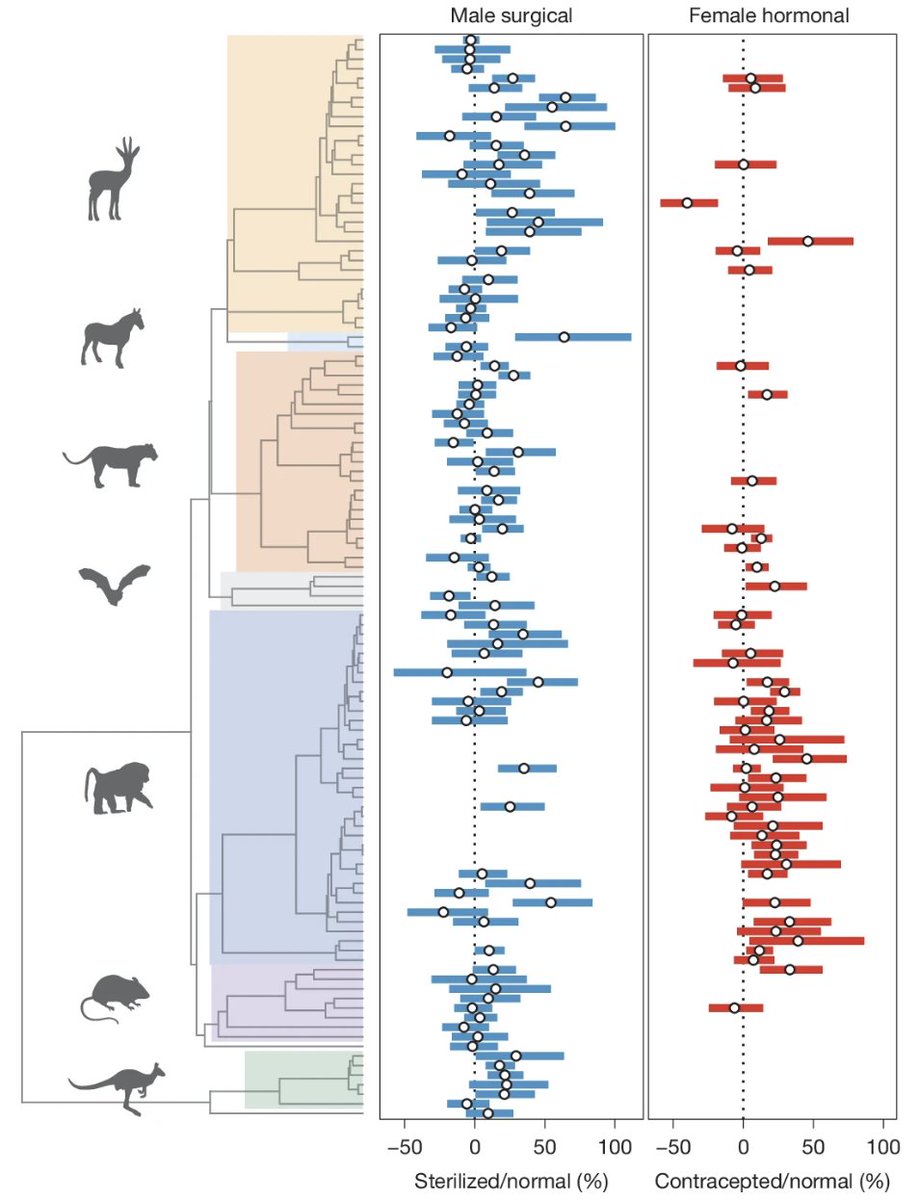
  11. Castration increases lifespan across vertebrates: Or at least, it feels longer.

    DD
    Dr. Dominic Ng@DrDominicNg · Dec 12

    Massive new @Nature study: castration increases lifespan across vertebrates (zoo mammals, rodents, wild animals).

    This aligns with historical human data: Korean eunuchs lived 14-19 years longer than their peers.

    Your move, @Bryan_Johnson.

  12. Pedagogy Recommendations:

    I think the single most thing important I can say is this: Every time you are inclined to use the word “teach”, replace it with “learn”. That is, instead of saying, “I teach”, say “They learn”. It’s very easy to determine what you teach; you can just fill slides with text and claim to have taught. Shift your focus to determining how you know whether they learned what you claim to have taught (or indeed anything at all!). That is much harder, but that is also the real objective of any educator.

  13. How Google Maps quietly allocates survival across London’s restaurants: It's amazing the rabbit holes people will go down.

    I needed a restaurant recommendation, so I did what every normal person would do: I scraped every single restaurant in Greater London and built a machine-learning model.

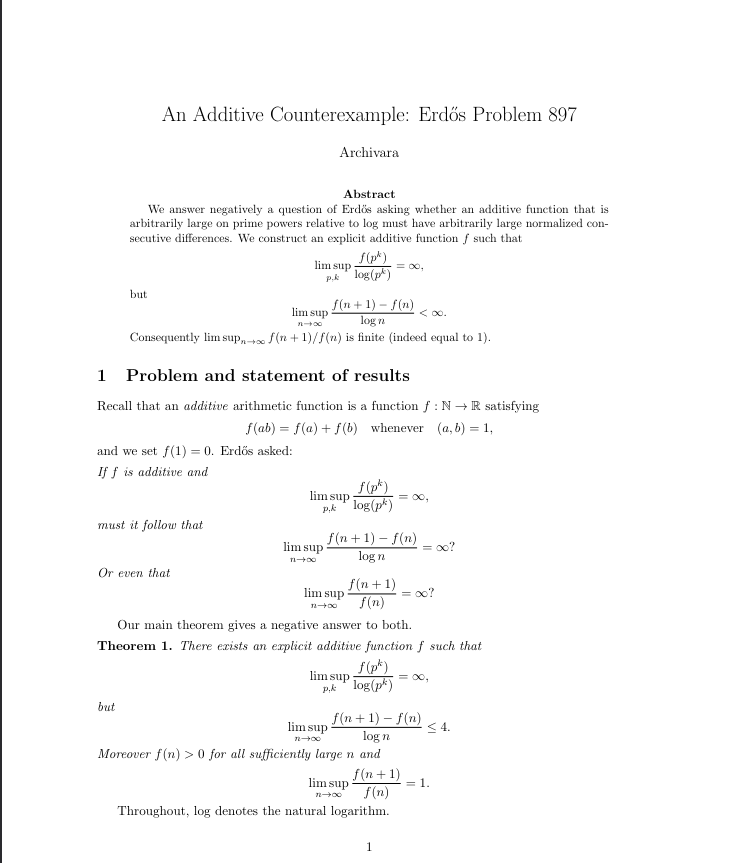
  14. I didn't think the current LLMs could solve "out-of-sample" problems, ones that are not in their training set. But I was wrong. And another one. These are hard problems from the looks of it.

    JS
    Johannes Schmitt@JohSch314 · Dec 17

    For the first time, an AI model (GPT-5) autonomously solved an open math problem submitted to our benchmarking project IMProofBench, with a complete, correct proof, without human hints or intervention.

    A small but novel contribution to enumerative geometry. Some background:

    S
    spicylemonade@spicey_lemonade · Dec 26

    🚨 Math + AI milestone 🚨

    Our Archivara Math Research Agent (in alpha) just became the first AI system to fully solve an Erdős problem on its own (zero human input or literature online).

    It produced a complete counterexample to Erdős Problem #897, resolving the question end-to-end. Proof is live online.

    This is AI doing real mathematics, autonomously.

  15. Automate your life with Claude Code:

  16. Copywriters reveal how AI has decimated their industry: It is coming for the white-collar jobs.

    AI is really dehumanizing, and I am still working through issues of self-worth as a result of this experience. When you go from knowing you are valuable and valued, with all the hope in the world of a full career and the ability to provide other people with jobs... To being relegated to someone who edits AI drafts of copy at a steep discount because “most of the work is already done” ...

  17. SK
    Séb Krier@sebkrier · Dec 13

    (I know I'm a stuck record) An important assumption in AI discourse is that sufficiently capable generalist *models* are the main event. Get the model smart enough, and it more or less does everything. Value creation, competitive advantage, and risk would all concentrate at the frontier training cluster. Post training and products were almost an afterthought: thin wrappers that would get eaten once models became capable enough to handle tasks end-to-end.

    I think this picture is wrong, and understanding why matters for how we think about AI trajectories (and risk and policy too, but that's for another post). In short:

    1. Local knowledge can't be centralized. Hayek's work on knowledge applies directly. The knowledge required to deploy AI usefully - what workflows need automation, what error rates are tolerable, how to integrate with existing systems, what users will adopt - is dispersed across millions of firms and contexts. It's often tacit and contextual rather than explicit and generalizable. A model can't just internalize this by training on more data, because much of it is generated in the moment through interaction with specific environments. Even arbitrarily capable models would still require an adaptation layer to translate general capability into specific value. (Note however that this doesn't mean the product layer *always* stays fragmented - you don't see a thousand Microsoft Words.)

    2. Products are where the translation happens. Cursor, Devin, vertical AI applications - these aren't thin wrappers waiting to be disrupted by the next model release. They're doing the hard work of integration, UX, workflow design, and context management. The scaffolding *is* the product. A better base model makes better scaffolding possible, but doesn't generate it spontaneously. I don't see Gemini 7 making Cursor obsolete. There's a reason Thinking Machines is deemed a viable business model!

    3. Efficiency is a permanent constraint, not a temporary bottleneck. Even today we see model routing, smaller models for lighter tasks, distillation, and labs offering model menus rather than just the largest thing they have. This is because of a Jevons-paradox-like dynamic. Even as compute gets cheaper, more use cases become viable, demand expands, and so efficiency still matters. You don't escape resource constraints with abundance; you just face them at a new scale. There will always be reasons to prefer lighter-weight specialized components over invoking maximum capability for every task.

    4. Specialization is a feature, not a limitation to overcome. Intelligence applied to a specific task in a specific context is more efficient than general intelligence reasoning from first principles every time. Even a hypothetical superintelligence would face this: why burn compute figuring out what's relevant when you can have pre-adapted components for known contexts? So you get specialization not because models aren't smart enough to generalize, but because specialization is how you minimize waste. For this not to matter you'd have to assume infinite free compute.

    5. What this implies for AI trajectories. But you don't get an omniscient model that centralizes all intelligence and value. You get something more like Drexler's CAIS picture - comprehensive AGI services composed of many specialized, adapted, efficiently-routed components. Agents will be useful, and drop-in generalist AI workers will proliferate, but like humans they will specialize, and this is a feature not a bug. The picture isn't "AGI arrives and one system does everything." It's "capabilities improve and this enables a richer ecosystem of specialized instantiations."

    So diffusion - getting AI usefully integrated into diverse contexts - matters just as much as development - pushing the frontier capability threshold. I feel like the discourse continues to underrate this, and the implications for policy and risk could be significant - but that's for another post.

  18. A curated list of the best finance blogs, tools, and webpages.

October 17, 2025 3 min read

Links: Week of 18 Oct 2025

  1. Happy Diwali to those who celebrate! NYT had two glossy stories on just one Diwali Ball in New York organized by Priyanka Chopra's manager. Made me go "Hmmm...". Was this about Diwali, was this about Priyanka Chopra or was this something else?

  2. London Became a Global Hub for Phone Theft. Now We Know Why. Not a fan of clickbait headlines in NYT TBH but this story was revealing. I was under the impression that phone theft was a thing of past because of the hard to crack passcodes. Turns out not. The article didn't make it very clear how the thieves could get the phones working again. Apparently they can be sold for parts and something something China. Anyway, time to be careful out there again.

  3. The pendulum has swung away from wokeness and cancel culture, as it should have. But sometimes it feels like, instead of passing through the center it went straight to the other end.

  4. Title Arbitrage as Status Engineering:

    Title arbitrage is one of the most scalable levers a company can pull to increase the status of certain roles and attract talent. It costs nothing, works at scale, yet has the ability to reshape labor markets. The design space for title arbitrage remains wide open.

  5. There are many ways through which the LLM subscriptions pay for themselves. For me it was physiotherapy. Here it is filing tax returns. I also wish more people would share "how tos" for solving different problems with LLMs. Here's a manual for tax returns. Full disclosure: I haven't tried it yet but the source is credible.

    PM
    Patrick McKenzie@patio11 · Oct 15

    @TheZvi Are you going to write an essay about that second thing or do I have to, because feels extremely obvious that there needs to be a URL “They can now successfully shake money tree for you *additively to what your highly paid advisor will do.*”

  6. Five technological achievements! (That we won’t see any time soon.):

  7. Observations on AI and the Capital Markets in 2025

    "To provide some sense of scale, that means the equivalent of about $1,800 per person in America will be invested this year on AI". That is a bucketload of spending.

  8. China Can't Win: Retweets are not endorsments, as they say. However there is a chorus of experts out there loudly claiming that China holds the upper hand in the tariff negotiations with US. I am not so sure and this looks like a worthwhile counterpoint. Added to reading list.

    China cannot win the decoupling because they face an impossible trilemma: protect the currency, bail out the banks, or maintain social stability. They can pick two at most. More likely, they get one. The math is unforgiving: $5-10 trillion in hidden property losses against $3 trillion in bank equity. That’s not a solvency problem—it’s a physics problem. Meanwhile, they’re bleeding $1.1 trillion annually just to hide the losses, burning their entire defense and R&D budget combined on financial zombies.

  9. Now that wokeness is over, is it ok to link to Louis CK clips again? Can one separate the art from the artist? I don't know but I love this one:

October 10, 2025 3 min read

Links: Week of 11 Oct 2025

  1. An Economists Guide to Weight Loss: Pre-Ozempic. New Year Resolution?

  2. The Patel Motel Story: I hope its well done. Must watch.

  3. 99 Percentile vs. 99.9 Percentile: Some of the responses are insightful too. This can be the problem of growing up in a small town or going to a "weaker" school for a certain type of person.

    JS
    Justin Skycak@justinskycak · Oct 4

    Last year I had a conversation with someone who majored in physics at UChicago. He initially started in math & thought he was prepared having taken AP Calculus BC, but he got smacked in the face by the level of abstraction and proof-writing ability that was assumed.

    He couldn't keep up with his classmates who had already done proofs while taking even MORE advanced courses in high school. So he switched to physics where proofs were less frequent & the playing field felt more level in terms of prior knowledge that classmates had coming in.

    He would have liked to study math if he had more time to catch up, or if he knew earlier how far behind he was – but he did great in his high school math classes & was recognized as one of the "smart kids," so he never suspected he was actually behind the curve.

    Zooming out, this case study is representative of a general phenomenon that can sneak up on you when you’re at, say, the 99th percentile of a skill.

    At first, you’re exceptional enough that you receive praise from virtually everyone, and you may never go head-to-head with someone who can beat you.

    That is, until you join some specialized program where everyone is at the 99.9th percentile – where, suddenly, you’re the worst one there.

    And here’s the real kicker: if it’s a time-sensitive program, you may be so far behind that it’s infeasible to catch up.

    If you knew the caliber of these people earlier, you could have spent time working harder to join their ranks in the 99.9th percentile…

    but that moment has passed, and now the door is closed on this opportunity.

  4. Bernie Madoff Stole My Savings. Here’s How I Got My Life Back.: Hats off.

    I think people who are facing a sudden reversal can learn from my experience. You can get through it. You have family, you have friends, you have resources that you don’t even know that you have.

  5. Average? I had to go down about 100 responses before someone asked, "Man or woman?"

    NS
    Noah Smith 🐇🇺🇸🇺🇦🇹🇼@Noahpinion · Oct 9

    Is 5'11" (180.3 cm) tall, average, or short?

August 29, 2025 2 min read

Links: Week of 30 Aug 2025

  1. IST: Indian Spotlight Time:

    Exploring the India that often escapes headlines through the lived experiences of an ABCG: American Born Confused Gora. It’s a look beyond polished narratives and the obvious into the beautiful contradictions that actually power the country.

  2. SD
    Sam D'Amico@sdamico · Aug 24

    A giant disconnect I see in society right now is the fact that self driving will absolutely take over, AI will absolutely enable 1:1 tutoring for every child, and the past benefits of “good school districts” and housing built around driving personal vehicles will make less sense.

  3. tokens are getting more expensive: A good discussion of why the AI Labs might stuggle with profitability.

    while it's true each generation of frontier model didn't get more expensive per token, something else happened. something worse. the number of tokens they consumed went absolutely nuclear.

  4. Patrick OShaughnessy podcast with Joe Liemandt, Principal @ Alpha School

  5. Failure of imagination is the only thing holding us back!

    “paula”@paularambles · Aug 27

    my mom just found a new use case for chatgpt

August 22, 2025 6 min read

Links: Week of 23 Aug 2025

  1. Why Is Martha’s Vineyard Going Vegan? It’s All About Tick Bites. (NYT):

    On the porch of the Chilmark General Store and at sunset-watching parties on Menemsha Beach, conversations circle ineluctably to the lone star tick, which after a single bite can leave people with a life-threatening allergy to most meat and dairy.

    Known as alpha-gal syndrome, the condition is changing the way many people shop, cook and eat in a place long known as a food-lover’s retreat for its thriving independent farms and restaurants. These new habits may prove to be lasting, as some islanders who initially avoided beef and cheese temporarily, out of necessity, later give them up for good out of preference.

    “It’s sort of supersized vegetarianism,” said Rebecca Miller, a farm owner who has the syndrome herself.

  2. Are Samosas Unhealthy? Some Indians Find Official Advice Hard to Swallow.:

    So, when a recent government advisory put samosas — along with other deep-fried Indian snacks and Western foods such as burgers and French fries — on a list of things that should be eaten in moderation because of their high oil and sugar content, there was an unsurprising outcry. Social media erupted with memes, and Indian media chimed in to say the country’s most iconic bites were under attack.

  3. @rivatez:

    That animals seemingly anticipate events should humble us more. Changes in groundwater chemistry, electromagnetic fields and sound waves make animals restless, distressed and even relocate

    In the West it is seen as ‘woo’ to contemplate that energy/weather humans don’t consciously experience can affect our psychology, and yet we forget that we are animals too.

    Even outside extreme weather events, the lunar cycle moves oceans, huge bodies of water. We are, like all animals, primarily made of water. The word ‘lunacy’ comes from the ancient understanding that our minds can be affected by it

    An interesting experiment is to log your daily mood for a few months- ups and downs, anxiety / joy levels, big arguments with loved ones etc. Then afterwards, retroactively chart it against lunar cycles and NASA space weather data that tracks geomagnetic storms, solar flares etc.

    Be open- minded and try it. I, too, used to think this stuff was BS

    Now I think much of modern psychiatry is giving people drugs to tune down people’s individual responses to these external inputs, eg ‘bipolar’ might just indicate high sensitivity

    How many important scientific breakthroughs lie on the other side of our collective dismissal of ‘woo’?

    cows
  4. Why I believe in AGI (again):

    First, I’m now convinced that ChatGPT understands what it reads. Second, reasoning models persuade me that ChatGPT is creative. Third, ChatGPT summarizes texts extremely well, which I believe to be a robust measure of intelligence.

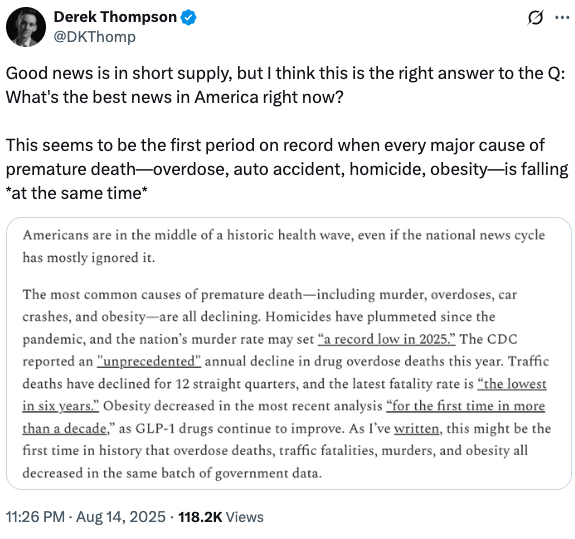
  5. Derek Thompson: Good News

    "The better news is that this is happening at a time when exercise seems to be increasing for many groups, especially the young and old. The bad news is ... deep Medicaid cuts and declines in childhood vaccine uptake are not exactly optimistic predictors of American health."

  6. Your Review: Dating Men In The Bay Area: Not what it says on the label at all! Recommended.

  7. Adults Are Going to Sleep-away Camp to Make Friends. It Seems to Actually Work.:

    “Anyone that has worked at camp or grown up in the camp world understands there is a powerful people connection that forms at camp,” said Liam Macleod, a longtime camp professional and marketing director at Camp No Counselors. “It’s camp magic and it’s hard to replicate in the regular world.”

  8. What is the most profitable thing you have done with ChatGPT? on Reddit via Simon Willison: In dollar terms, probably crafting fundraising messages for charity event organized by my Alumni Association. In real terms, physiotherapy for my back and legs. So far. Some great examples at the link. Failure of imagination remains the biggest hurdle in getting value from LLMs.

  9. AI Is Designing Bizarre New Physics Experiments That Actually Work:

    It took months of effort to understand what the AI was doing. It turned out that the machine had used a counterintuitive trick to achieve its goals. It added an additional three-kilometer-long ring between the main interferometer and the detector to circulate the light before it exited the interferometer’s arms. Adhikari’s team realized that the AI was probably using some esoteric theoretical principles that Russian physicists had identified decades ago to reduce quantum mechanical noise. No one had ever pursued those ideas experimentally. “It takes a lot to think this far outside of the accepted solution,” Adhikari said. “We really needed the AI.”

  10. GPT-5 prompting guide:

    GPT-5, our newest flagship model, represents a substantial leap forward in agentic task performance, coding, raw intelligence, and steerability.

    While we trust it will perform excellently “out of the box” across a wide range of domains, in this guide we’ll cover prompting tips to maximize the quality of model outputs, derived from our experience training and applying the model to real-world tasks. We discuss concepts like improving agentic task performance, ensuring instruction adherence, making use of newly API features, and optimizing coding for frontend and software engineering tasks - with key insights into AI code editor Cursor’s prompt tuning work with GPT-5.

    We’ve seen significant gains from applying these best practices and adopting our canonical tools whenever possible, and we hope that this guide, along with the prompt optimizer tool we’ve built, will serve as a launchpad for your use of GPT-5. But, as always, remember that prompting is not a one-size-fits-all exercise - we encourage you to run experiments and iterate on the foundation offered here to find the best solution for your problem.

    And a tutorial by Anthropic.

  11. Class Dismissed: Alpha School is getting a lot of coverage all of a sudden. Long piece about the people and the tech behind it.

August 1, 2025 6 min read

Links: Week of 02 Aug 2025

  1. Philosopher–Builder Summer Reads:

    These aren't generic "tech books." They're works that can shape how serious builders think about what they're creating and why.

    And the original essay.

  2. DOGE builds AI tool to cut 50 percent of federal regulations:

    The tool, called the “DOGE AI Deregulation Decision Tool,” is supposed to analyze roughly 200,000 federal regulations to determine which can be eliminated because they are no longer required by law, according to a PowerPoint presentation obtained by The Post that is dated July 1 and outlines DOGE’s plans. Roughly 100,000 of those rules would be deemed worthy of trimming, the PowerPoint estimates — mostly through the automated tool with some staff feedback. The PowerPoint also suggests the AI tool will save the United States trillions of dollars by reducing compliance requirements, slashing the federal budget and unlocking unspecified “external investment.”

    A worthy goal for DOGE and possibly the right use of AI. If done well.

  3. America's AI Action Plan Is Pretty Good:

    Otherwise, while this is far from a perfect plan or the plan I would choose, on the substance it is a good plan, a positive plan, with many unexpectedly good plans within it. There is a lot of attention to detail in ways those I’ve asked say reflect people who actually know what they are doing, which was by no means something to be taken for granted. It is hard to imagine that a much better plan could have been approved given who was doing the approving.

  4. JF
    Jim Fan@DrJimFan · Jul 25

    I'm observing a mini Moravec's paradox within robotics: gymnastics that are difficult for humans are much easier for robots than "unsexy" tasks like cooking, cleaning, and assembling. It leads to a cognitive dissonance for people outside the field, "so, robots can parkour & breakdance, but why can't they take care of my dog?" Trust me, I got asked by my parents about this more than you think ...

    The "Robot Moravec's paradox" also creates the illusion that physical AI capabilities are way more advanced than they truly are. I'm not singling out Unitree, as it applies widely to all recent acrobatic demos in the industry. Here's a simple test: if you set up a wall in front of the side-flipping robot, it will slam into it at full force and make a spectacle. Because it's just overfitting that single reference motion, without any awareness of the surroundings.

    Here's why the paradox exists: it's much easier to train a "blind gymnast" than a robot that sees and manipulates. The former can be solved entirely in simulation and transferred zero-shot to the real world, while the latter demands extremely realistic rendering, contact physics, and messy real-world object dynamics - none of which can be simulated well.

    Imagine you can train LLMs not from the internet, but from a purely hand-crafted text console game. Roboticists got lucky. We happen to live in a world where accelerated physics engines are so good that we can get away with impressive acrobatics using literally zero real data. But we haven't yet discovered the same cheat code for general dexterity.

    Till then, we'll still get questioned by our confused parents.

  5. Two long & good pieces on India this week though I have yet to fully read both.

  6. Jhanas and Jhourney:

    So I went down to the beach. "Kinda nice", I thought. The sky had a particularly vibrant blue color, the waves had 'the right size', their roar was pleasant. I started to walk around trying to continue meditating. I focused my awareness on an arising sensation of open heartedness and then I noticed my eyes tearing up ("Huh? I thought"). I looked again at the ocean and then I saw it. It was fucking amazing. So much color and detail: waves within waves, the fractal structure of the foamy crests as they disintegrate back into the ocean. The feeling of the sun on my skin. I felt overwhelmed. As tears ran down my face and lowkey insane grin settled on my face I found myself mumbling "It's... always been like this!!!!" "What the fuck??!" followed by "This is too much!! Too much!!!". The experience seemed to be demanding from me to feel more joy and awe than I was born to feel or something like that. In that precise moment I felt what "painfully beautiful" means for the first time in my life. I had to look away. I calmed a bit. I walked a few steps and looked back. The exact same thing happened. "It's reproducible, hihihihi", and I started laughing. Then I found a log to sit on, calm down, and look back at the ocean. Now it wasn't overwhelming, but "kinda nice" was now "fucking amazing".

    To do list.

  7. Yes, Adam Sandler really is a pickup basketball god (NYT Paywall):

    Jackson was struck by the man’s attire: extra-baggy shorts and an extra-baggy yellow T-shirt. “I’m trying to figure out: Does he buy clothes? Did he buy them and then just stop buying them? His clothes really might have been from 2008.” It soon became apparent, however, that the guy could play. He was a true court general. He impressed Jackson with his basketball IQ.

  8. RW
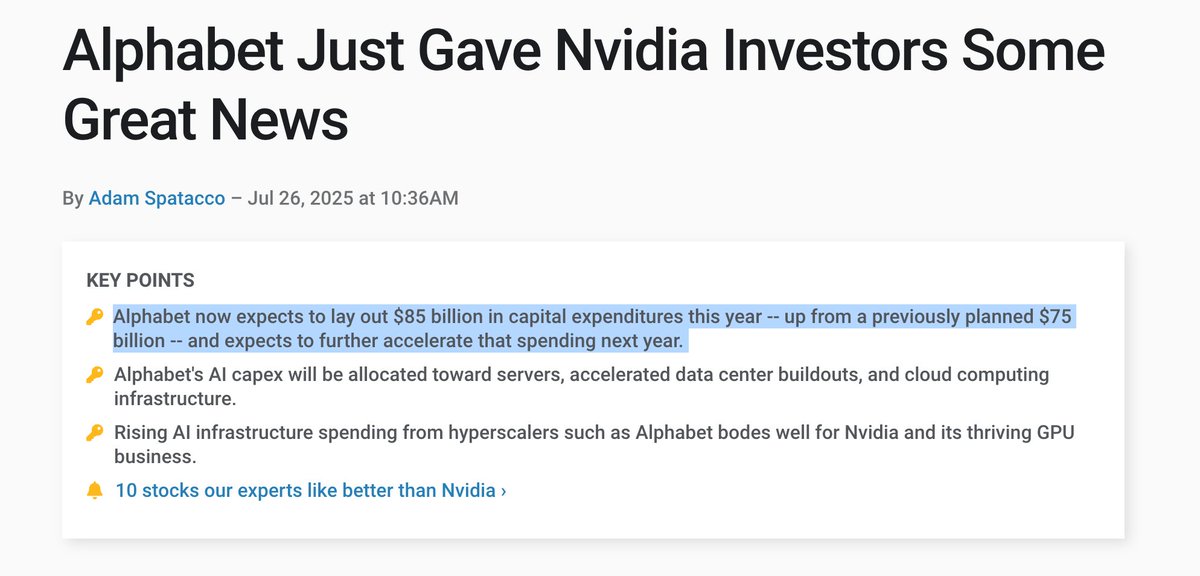
    Rob Wiblin@robertwiblin · Aug 1

    Google now spends more on physical capital like datacentres ($85 billion / year) than the entire UK defence budget ($79 billion / year).

  9. Life in deep:

    When her three-person submersible descended more than 30,000 feet into one of the Pacific Ocean’s deepest trenches, Mengran Du wasn’t sure what they would find.

    What she saw, she recalled, was “unbelievable”: Dense clusters of tubeworms with tentacles tinged bloodred, jutting up like skyscrapers. Iridescent snails scaling the worms, like window washers. Bristly, white creatures wriggling between them like rush-hour commuters trying to get home for dinner.

  10. UJ
    UAP James@UAPJames · Jul 31

    NEW: Senator Mike Rounds says credible U.S. Govt whistleblowers have provided him with testimony in classified settings on transmedium UAP.

    “It can be both underwater and in the air and can apparently move to very, very high altitudes in a very short period of time.”

    “They’re not making this stuff up. There’s something there. We just don’t know what it is.”

  11. J
    John_Hempton@John_Hempton · Jul 26

    Fartcoin market cap is still over a billion dollars.

    The boys who started this one have probably cashed >100 million.

    You have the wrong career. So do I.

July 20, 2025 3 min read

Links: Week of 19 Jul 2025

  1. The Diaspora Paradox Second in a series from Samir Varma

    But here's the paradox that has haunted me for decades: Why do so many Indians who escape India's constraints become more Indian abroad? Why does the uncle who couldn't be bothered to visit temples in Mumbai suddenly become a founding member of the Hindu temple in New Jersey? Why does the software engineer who rebelled against arranged marriage in Bangalore now insist their American-born daughter marry within the community?

  2. The First in 30 Years: Scientists Discover New Class of Antibiotics:

    Led by scientist Gerry Wright, the team has discovered a powerful new molecule called lariocidin. This promising candidate shows the ability to fight some of the toughest, most drug-resistant bacteria known to science. Their groundbreaking findings were published in the journal Nature.

  3. Why We’re Surrounding Our Kids with AI:

    We also don’t plan on perpetuating modern Western parents’ egregiously hands-off nature with regard to their kids’ dating and marriage prospects. We already have a going list of agentic, thoughtful, high-achieving families whose kids are close to our kids in age; as our kids get older, we’ll start organizing gatherings for families in this network where our kids can hang out and get to know each other (trips, summer camps, discord servers, study groups, etc.). As our kids reach their late teens and early 20s, we’ll begin organizing modern versions of the London Season—a series of events and gatherings at which our single kids ready for marriage can meet, mix, and get to know each other.

    Did not see this coming.

  4. Babies made using three people's DNA are born free of hereditary disease:

    Eight babies have been born in the UK using genetic material from three people to prevent devastating and often fatal conditions, doctors say.

    The method, pioneered by UK scientists, combines the egg and sperm from a mum and dad with a second egg from a donor woman.

  5. The Sputnik vs. Deep Seek Moment: The Answers

    I pointed out that the US response to Sputnik was fierce competition. Following Sputnik, we increased funding for education, especially math, science and foreign languages, organizations like ARPA were spun up, federal funding for R&D was increased, immigration rules were loosened, foreign talent was attracted and tariff barriers continued to fall. In contrast, the response to what I called the “DeepSeek” moment has been nearly the opposite. Why did Sputnik spark investment while DeepSeek sparks retrenchment? I examine four explanations from the comments and argue that the rise of zero-sum thinking best fits the data.

  6. Reflections on OpenAI:

    I left OpenAI three weeks ago. I had joined the company back in May 2024.

    I wanted to share my reflections because there's a lot of smoke and noise around what OpenAI is doing, but not a lot of first-hand accounts of what the culture of working there actually feels like.

  7. ChatGPT Agent and Gold-medal level performance in International Math Olympiad (IMO). More on the IMO.

  8. Psychological techniques to persuade AI.

  9. Spud-tacular: How India became a french fry superpower:

    Gujarat has become India's capital of french fry production, home to huge factories churning out chips, including facilities belonging to Canadian giant McCain Foods and India's biggest maker of French Fries, HyFun Foods.

  10. Bill Ackman changed Tennis forever.

May 9, 2025 3 min read

Links: Week of 10 May 2025

  1. You Sent the Message. But Did You Write It?: Hilarious.

    Chatcident: When someone slips and pastes the prompt into the chat or email instead of the polished AI output – exposing the wizard behind the curtain.

  2. Points for kills: How Ukraine is using video game incentives to slay more Russians:

    Ukraine's military is turning to incentive schemes used in video games to spur its soldiers to kill more Russian troops and destroy their equipment.

    The program — called Army of Drones bonus — rewards soldiers with points if they upload videos proving their drones have hit Russian targets. It will soon be integrated with a new online marketplace called Brave 1 Market, which will allow troops to convert those points into new equipment for their units.

  3. How far are you from India, measured in units of India?: I really need to update the site to show Tweets inline or at least display images. Hope Claude is up to the task.

  4. This Is the Moment for Mexican Indian Food to Flourish (NYT): A marriage made in heaven. Literally.

    A small, close-knit Mexican Indian American community formed outside Sacramento when a generation of Punjabi Sikh and Muslim men immigrated from India to find work as farmers and loggers beginning in the late 1800s. After the Immigration Act of 1917 made it near impossible for Indian women to immigrate, hundreds of these men married Mexican women. New kinds of cooking emerged from their idiosyncratic home kitchens and a handful of restaurants the families went on to run.

  5. Lego built full-size F1 cars for the Miami GP drivers’ parade.

    “That was the most fun drivers’ parade we’ve ever had,” Ferrari’s Lewis Hamilton said. “Some dirty driving from this one here (Gasly)! That was great fun.”

    “They’ll have to sweep the track, there’s quite a bit of Lego debris on the track,” Max Verstappen said. “A bit different, that’s for sure!”

  6. Tim Urban on AI. In 2015.: Really need to add the Tweet feature.

  7. Unparalleled Misalignments: I think I have shared this before but some things are worth sharing twice.

    This is a list of Unparalleled Misalignments, pairs of non-synonymous phrases where the words in one phrase are each synonyms of the words in the other.

    Butt dial // Booty call

    Father figure // Dad bod

    Local girl // Near miss

  8. Globalization did not hollow out the American middle class

  9. Pro-Prompting: A master in action. Prompt used for GeoGuessr by Kelsey Tuoc, in the last week's link on AI playing GeoGuessr.

  10. Boy Accidentally Orders 70,000 Lollipops on Amazon. Panic Ensues. (NYT) :

On Sunday morning, as Holly LaFavers was preparing to go to church, a delivery worker dropped off a 25-pound box of lollipops in front of her apartment building in Lexington, Ky.

And another. And then another. Soon, 22 boxes of 50,600 lollipops were stacked five boxes high in two walls of Dum-Dums. That was when Ms. LaFavers heard what no parent wants to hear: Her child had unwittingly placed a massive online order.

“Mom, my suckers are here!” said her son, Liam, who had gone outside to ride his scooter.

“I panicked,” Ms. LaFavers, 46, said. “I was hysterical.”

March 21, 2025 4 min read

Links: Week of 22 Mar 2025

  1. The Kids Are Not All Right via MR: Reminder that humans, often the smartest humans, can believe anything. Wonder how much of the coventional wisdom today falls in this category.

    Two weeks after his birth, Jeffrey’s health took a turn for the worse: He developed a heart defect common in premature infants – patent ductus arteriosus, or PDA. Jeffrey was scheduled for open-heart surgery and transferred to the nearest children’s hospital.

    In those days, surgery for PDA was invasive. Holes were cut on either side of Jeffrey’s tiny neck and chest to insert a catheter into his jugular vein. His little body was opened from breastbone to backbone, his flesh lifted aside, ribs pried apart, and a blood vessel near his heart tied off, and then all the tissues were stitched back together.

    Baby Jeffrey felt everything – every incision, every internal repair, every stitch. The medical team had not given their fragile patient any drugs, any comfort, anything to protect him from the excruciating pain of open-heart surgery – just a paralyzing agent to keep him still during the procedure.

    Five weeks later, Jeffrey passed away.

    In the days before her child’s death, Jill Lawson learned a shocking fact: Anesthetizing babies for surgery was not common practice. After Jeffrey died, Lawson called his doctor for reassurance. Surely, she thought, her child had been given something for the pain.

    “The anesthesiologist informed me that she had not used any anesthesia or analgesia on Jeffrey,” Lawson wrote in an account of her son’s experience. The doctor told the grieving mother it hadn’t even occurred to her to do so because it had never been demonstrated that babies can feel pain.

  2. @peelraja via MR:

    The paradox of India:

    Punjab is over 60% vegetarian, but Tandoori chicken and butter chicken are its most popular dishes outside the state.

    Tamil Nadu is less than 1% vegetarian, but its "pure veg" idly, dosa, sambhar, pongal, etc are its most popular dishes outside the state.

  3. The Seneca via Daring Fireball:

    The Seneca is my middle finger to the aesthetic homogeneity and economic over-optimization of 21st century life.

    A keyboard for the low, low price of $3,600. Yes, a computer keyboard. Yes, US$. Although to be fair, it is not $3,600. Its "from $3,600".

  4. My Thoughts on the Future of "AI" via Simon Willison:

    I have very wide error bars on the potential future of large language models, and I think you should too.

    Specifically, I wouldn't be surprised if, in three to five years, language models are capable of performing most (all?) cognitive economically-useful tasks beyond the level of human experts.

    And I also wouldn't be surprised if, in five years, the best models we have are better than the ones we have today, but only in “normal” ways where costs continue to decrease considerably and capabilities continue to get better but there's no fundamental paradigm shift that upends the world order.

  5. The Anatomy of Marital Happiness via MR:

    Since 1972, the General Social Survey has periodically asked whether people are happy with Yes, Maybe or No type answers. Here I use a net “happiness” measure, which is percentage Yes less percentage No with Maybe treated as zero.

    Average happiness is around +20 on this scale for all respondents from 1972 to the last pre-pandemic survey (2018). However, there is a wide gap of around 30 points between married and unmarried respondents.

    This “marital premium” is this paper’s subject. I describe how this premium varies across and within population groups. These include standard socio demographics (age, sex, race education, income) and more. I find little variety and thereby surface a notable regularity in US socio demography: there is a substantial marital premium for every group and subgroup I analyze, and this premium is usually close to the overall 30-point average.

    This holds not just for standard characteristics but also for those directly related to marriage like children and sex (and sex preference). I also find a “cohabitation premium”, but it is much smaller (10 points) than the marital premium. The analysis is mainly visual, and there is inevitably some interesting variety across seventeen figures, such as a 5-point increase in recent years.

January 18, 2025 5 min read

Links: Week of 19 Jan 2025

  1. This feels accurate. 😅. He says AGI but looking at the next link I wonder if this is true for plain old AI.

    DK
    David Krueger 🦥 ⏸️ ⏹️ ⏪@DavidSKrueger · Jan 15

    99.99% of people talking about AGI

  2. Two weeks ago, it was Will Smith eating pizza. Now its this. Click the link to see the video. WhatsApp University is about to go nuts.

    EM
    Ethan Mollick@emollick · Jan 13

    I don't think people know that making plausible fake videos is now something that doesn't require a lot of skill or time

    I made this Veo video of a man trying out a flying skateboard at CES from a text prompt, 2nd try. Notice the shadows, green light, his body shifts for balance

  3. She Is in Love With ChatGPT (NSFW. NYT Paywall.) And you thought K-Dramas were stealing your spouse.

  4. The Serendipity Machine or how to use Twitter better. A few years ago I implemented a simple algorithm on my twitter feed:

    a. Block everyone who talks about politics and

    b. Block everyone who is is dissing / attacking anyone / anything.

    In less than a month my feed stopped being the anxiety inducing, doomscrolling nightmare that it was and transformed into the best source of learning & inspiration on internet. This piece takes you to the next level.

    Committing to writing this newsletter has also been great. Now instead of mindlessly flicking my finger and consuming, I have a purpose every time I open Twitter. Its almost energising to engage actively with each tweet, thoughtfully considering whether its fit to be served to my exceptionally smart and good-looking audience.

  5. E(X)>0: An Open Letter to Elon:

    “Your top engineers and programmers are only able to work 80-hour weeks because they can hire nannies and maids, ride in Ubers, and order food delivery. High-skill productivity depends on an abundance of complementary low-skill productivity.”

    As a repeat immigrant, I have many thoughts on this debate going on in US right now. There’s a lot that is wrong with a policy of focusing exclusively on so called Skill or Merit based immigration. This piece from Bryan Caplan makes some good points.

  6. The War for India: I am enjoying this talk by Prof. Sarah Paine of the Naval War College. She talks about the history of international conflict and politics in South Asia and the role to US & Russia. I did not know that India supported China’s bid for a permanent seat on the UN Security Council. 🤯 😱

  7. Better ways to wear a Polo: Always a pleasure to see a master in action.

    DG
    derek guy@dieworkwear · Jan 16

    I disagree. This outfit is terrible and I will show you better ways to wear a polo. 🧵

    DG
    derek guy@dieworkwear · Jan 16

    Like the fedora, it's also saddled with bad social connotations: rich pricks who run on family ties, golfing uncles, and business casual guys at networking conferences where there's plated cantaloupe.

“…networking conferences where there’s plated cantaloupe.” chef’s kiss.

Here’s another one from Derek:

DG
derek guy@dieworkwear · Jan 13

when you're trying to hold a fart

  1. Fix Your Glutes. (NYT Paywall) Strongly endorse. Really helps when trying to hold a fart but many other benefits too.

    My frail-as-porcelain glutes — the cluster of tissue from hip to thigh tasked with keeping the body upright and on occasion propelling it forward — were causing a domino chain of damage, and had most likely been doing so for some time. To compensate for the glutes’ infirmity, my ankles, knees, hips and even my shoulders and arms had to thrash madly, taking on vast and uneven amounts of pressure, often far more than they were structurally fit to bear

    and

    Only after I started remedying my “gluteal amnesia” (real medical term) did it become clear how little I knew about basic affairs like walking, standing and sitting (or living, for that matter). Within a week of the mandated twisting and shimmying and clam-shelling, my spine was noticeably straighter, smoother. Four weeks later and I could finally walk without pain again. It took three months more to fully rebalance my loopy musculature and break into a manageable jog — but when I did, I noticed a wondrous new power to each step and spring. My reawakened haunch muscles were doing their job.

    For the last two months, I have been doing a core workout formulated personally for me by (who else?) ChatGPT, with a special focus on glutes and I can feel the difference, not just in my ability, but my willingness to do things. Core strength is underrated and it isn’t just about the abs. You can have a six-pack and a weak core. I happen to have one of those.

That’s it for this week. It seems like my writing and links are all AI all the time but that isn’t the intention. However it is a space where a lot of fun stuff is happening right now and so that’s the path of least resistant.

I will be on the road for the next few weeks so programming may be light. Hopefully the website will be ready soon.

×