Links: Weeks of 20 & 27 Dec 2025
A long one to mark a year of link posts. Starting with feel-good stories for the festive season.
The best story you’ll read this Christmas. Truly.
JCYour Social Muscles Are Wasting Away. Here Is How to Retrain Them.: Everything old is new again and the search for connection is timeless.
I’m a married 41-year-old woman who lives with housemates by choice. Rather than trying to acquire as much space and privacy as we could as quickly as we could, my husband and I decided to do the opposite. Parenting in our mid-30s, bursting out of our small London flat, we rented and then bought a London home with another couple.
Sisters in Sweat: A couple years ago I played soccer every saturday morning, for about a year. Great memories. I get this. New year resolution.
SiS has become a lifeline for thousands of women like Almeida in India, helping build a rare space where sport turns into an experience of liberation and camaraderie.
How I read: I have stopped reading long form for a while, so I am a sucker for these guides. Not a New Year resolution though.
One of the many joys of living in New York City is the library system. The Performing Arts Library and Stavros Niarchos Foundation Library (on Fifth Ave across from the main branch) are both delightful places to spend a few hours in Manhattan, and in Brooklyn I spent more than my fair share of afternoons at the Grand Army Plaza main branch. I pick a section and walk the shelves until I get hungry, thirsty, or under-caffeinated.
I count AI summarized books as “Read”: Possibly a New Year resolution.
I upload books to Claude and ask it to “Comprehensively and engagingly summarize and fact-check, writing in Malcolm Gladwell’s style, the book …”. I can read it in an hour instead of twelve. Four bullet points instead of forty. With (this surprised me) roughly the same number of insights I actually do something with.
Ruby's Ultimate Guide to Thoughtful Gifts: New Year resolution?? Who am I kidding?
Give a man a gift and he smiles for a day. Teach a man to gift and he’ll cause smiles for the rest of his life.
The Lost Generation: Tough reading.
At the time, I blamed those women. Of course I did. They’ve since ascended the TV ladder and work as co-executive producers on major shows. On some level, even today I can’t help but think: That could have been me. That should have been me.
But those women didn’t take our jobs any more than the 50-year-old Hollywood lifers had. The lifers were still there. They’re still there. And I’m not angry at the women and people of color who made it instead of me—people have the right, in most cases the responsibility, to take the opportunities that are offered them—or even at the older white guys who ensured that I didn’t.
Paranoia: A Beginner's Guide: Worth reading just for the first line.
People sometimes make mistakes. (Citation Needed)
Chemical hygiene: A good follow up to the previous link?
How Did the C.I.A. Lose a Nuclear Device? Where else but in India?
A plutonium-packed generator disappeared on one of the world’s highest mountains in a hush-hush mission the U.S. still won’t talk about.
Castration increases lifespan across vertebrates: Or at least, it feels longer.
DDMassive new @Nature study: castration increases lifespan across vertebrates (zoo mammals, rodents, wild animals).
This aligns with historical human data: Korean eunuchs lived 14-19 years longer than their peers.
Your move, @Bryan_Johnson.
-
I think the single most thing important I can say is this: Every time you are inclined to use the word “teach”, replace it with “learn”. That is, instead of saying, “I teach”, say “They learn”. It’s very easy to determine what you teach; you can just fill slides with text and claim to have taught. Shift your focus to determining how you know whether they learned what you claim to have taught (or indeed anything at all!). That is much harder, but that is also the real objective of any educator.
How Google Maps quietly allocates survival across London’s restaurants: It's amazing the rabbit holes people will go down.
I needed a restaurant recommendation, so I did what every normal person would do: I scraped every single restaurant in Greater London and built a machine-learning model.
I didn't think the current LLMs could solve "out-of-sample" problems, ones that are not in their training set. But I was wrong. And another one. These are hard problems from the looks of it.
JSFor the first time, an AI model (GPT-5) autonomously solved an open math problem submitted to our benchmarking project IMProofBench, with a complete, correct proof, without human hints or intervention.
A small but novel contribution to enumerative geometry. Some background:S🚨 Math + AI milestone 🚨
Our Archivara Math Research Agent (in alpha) just became the first AI system to fully solve an Erdős problem on its own (zero human input or literature online).
It produced a complete counterexample to Erdős Problem #897, resolving the question end-to-end. Proof is live online.
This is AI doing real mathematics, autonomously.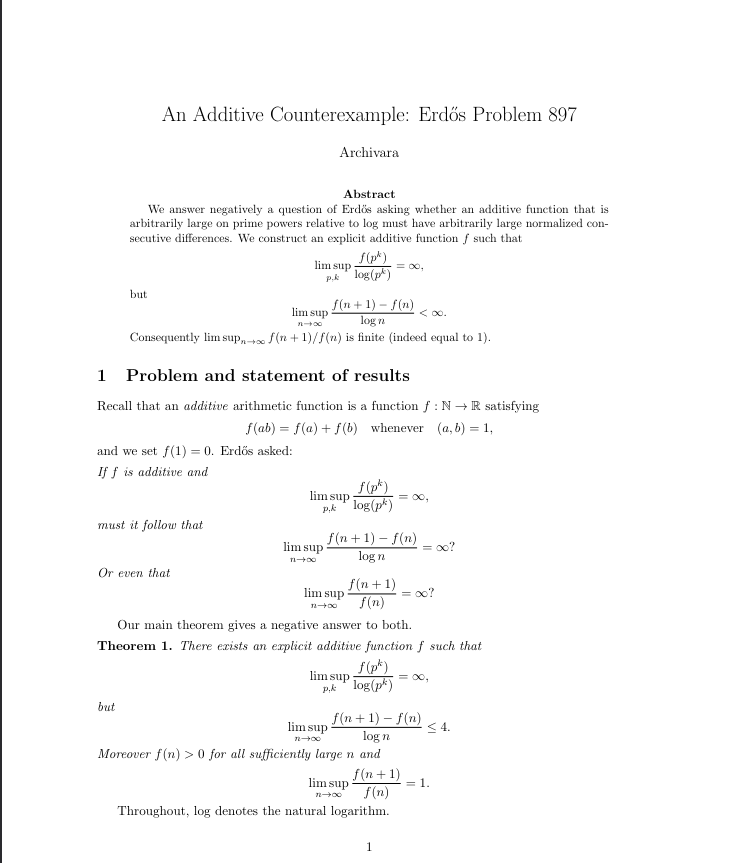
Copywriters reveal how AI has decimated their industry: It is coming for the white-collar jobs.
AI is really dehumanizing, and I am still working through issues of self-worth as a result of this experience. When you go from knowing you are valuable and valued, with all the hope in the world of a full career and the ability to provide other people with jobs... To being relegated to someone who edits AI drafts of copy at a steep discount because “most of the work is already done” ...
- SK
(I know I'm a stuck record) An important assumption in AI discourse is that sufficiently capable generalist *models* are the main event. Get the model smart enough, and it more or less does everything. Value creation, competitive advantage, and risk would all concentrate at the frontier training cluster. Post training and products were almost an afterthought: thin wrappers that would get eaten once models became capable enough to handle tasks end-to-end.
I think this picture is wrong, and understanding why matters for how we think about AI trajectories (and risk and policy too, but that's for another post). In short:
1. Local knowledge can't be centralized. Hayek's work on knowledge applies directly. The knowledge required to deploy AI usefully - what workflows need automation, what error rates are tolerable, how to integrate with existing systems, what users will adopt - is dispersed across millions of firms and contexts. It's often tacit and contextual rather than explicit and generalizable. A model can't just internalize this by training on more data, because much of it is generated in the moment through interaction with specific environments. Even arbitrarily capable models would still require an adaptation layer to translate general capability into specific value. (Note however that this doesn't mean the product layer *always* stays fragmented - you don't see a thousand Microsoft Words.)
2. Products are where the translation happens. Cursor, Devin, vertical AI applications - these aren't thin wrappers waiting to be disrupted by the next model release. They're doing the hard work of integration, UX, workflow design, and context management. The scaffolding *is* the product. A better base model makes better scaffolding possible, but doesn't generate it spontaneously. I don't see Gemini 7 making Cursor obsolete. There's a reason Thinking Machines is deemed a viable business model!
3. Efficiency is a permanent constraint, not a temporary bottleneck. Even today we see model routing, smaller models for lighter tasks, distillation, and labs offering model menus rather than just the largest thing they have. This is because of a Jevons-paradox-like dynamic. Even as compute gets cheaper, more use cases become viable, demand expands, and so efficiency still matters. You don't escape resource constraints with abundance; you just face them at a new scale. There will always be reasons to prefer lighter-weight specialized components over invoking maximum capability for every task.
4. Specialization is a feature, not a limitation to overcome. Intelligence applied to a specific task in a specific context is more efficient than general intelligence reasoning from first principles every time. Even a hypothetical superintelligence would face this: why burn compute figuring out what's relevant when you can have pre-adapted components for known contexts? So you get specialization not because models aren't smart enough to generalize, but because specialization is how you minimize waste. For this not to matter you'd have to assume infinite free compute.
5. What this implies for AI trajectories. But you don't get an omniscient model that centralizes all intelligence and value. You get something more like Drexler's CAIS picture - comprehensive AGI services composed of many specialized, adapted, efficiently-routed components. Agents will be useful, and drop-in generalist AI workers will proliferate, but like humans they will specialize, and this is a feature not a bug. The picture isn't "AGI arrives and one system does everything." It's "capabilities improve and this enables a richer ecosystem of specialized instantiations."
So diffusion - getting AI usefully integrated into diverse contexts - matters just as much as development - pushing the frontier capability threshold. I feel like the discourse continues to underrate this, and the implications for policy and risk could be significant - but that's for another post.
A curated list of the best finance blogs, tools, and webpages.
