Links: Week of 03 Jan 2026
‘I Was Just So Naïve’: Inside Marjorie Taylor Greene’s Break With Trump: Starting the new year with a revelation - people can surprise you.
"“After Charlie died, I realized that I’m part of this toxic culture. I really started looking at my faith. I wanted to be more like Christ.”
Kazuyoshi Miura, 58, signs with new club to extend record-breaking soccer career - The Athletic:
He’s known as “King Kazu” in Japan and has played 40 professional seasons dating back to the mid-1980s. He started in Brazil’s Serie A, the country’s top division, with Santos in 1986. He has had brief, varying spells abroad over the course of his career, in Australia, Italy, and Croatia, all before 2000, when he returned to Japan for good, firstly with Kyoto Purple Sanga in 1999.
Beginner’s Guide to the Mahabharata and Ramayana:
Do you desire to know the stories of India’s two great epics, but are intimidated by the massive tomes with hundreds of characters and thousands of pages full of sentences like this: “Ugrasrava, the son of Lomaharshana, surnamed Sauti, well-versed in the Puranas, bending with humility, one day approached the great sages of rigid vows, sitting at their ease, who had attended the twelve years’ sacrifice of Saunaka, surnamed Kulapati, in the forest of Naimisha.”
Well if so, I’ve got just the guide for you!
The Prison Of Financial Mediocrity: I saw this a fair bit on my timeline. The response in the tweet below makes a lot more sense to me though.
A 25-year-old making $70k is constantly fed content from people their age making $2mn, living in Bali, "working" four hours a day. The baseline for "enough" keeps moving.
You never catch up. No matter what you achieve, social media will show you what you're missing. The spread between your life and the life you "should" have is maintained algorithmically, forever uncollapsible.
So you have AI shrinking your timeline AND social media ensuring you never feel like you've arrived. The pressure to escape, NOW, FAST, before it's too late, compounds daily.
JLEveryone's sharing that "Long Degeneracy" article and nominating it for article of the year with 20m views. I just got around to reading it…overall, I get it. It's well written, emotionally resonant, and captures something real about generational anxiety. I like the author, I subscribe to their stuff… talented Quant.
But nobody's pushing back, so let me while I watch my kids at the pool.
My main pushback is this: the article is a suicide note dressed up as investment advice. I REFUSE to hand my agency to "the house." The moment you accept "the game is rigged so I might as well gamble," you've surrendered. You've quit on the process that actually works because someone convinced you it doesn't. There are no easy buttons. No shortcuts. No magic money options. There is only learning, sacrifice, and continual grit.
It tells a generation they're prisoners. Then it sells them a lottery ticket and calls it freedom. Then it tells YOU to invest in the prison.
That's not analysis. That's despair with a ticker symbol.
The author spends 2000 words empathizing with young people as "prisoners" trapped by a broken economy… then tells you to invest in the platforms extracting fees from their desperation. "Long Coinbase, long DraftKings, long the casinos."
Read that again. The thesis is: a generation is so economically desperate they're turning to gambling, most will lose, and YOU should profit by owning the house.
You can't weep for the prisoners and then sell shares in the prison. Pick one.
4 points I want to make....
Pushback 1: "Closed" is doing a lot of work
The claim that traditional wealth building is "closed, not difficult" is asserted, not proven. The boomer vs millennial wealth stat is misleading… it compares 65 year olds to 35 year olds. Of course boomers hold more wealth. They've been alive longer.
Housing is brutal in coastal cities. But median home prices in most US metros are still accessible to dual income households. "Wages up 8% while housing doubled" has no timeframe and cherry picks the comparison. Real wages post 2020 have actually grown.
Is it harder than it was? Yes. Is the game "fundamentally broken"? That's a much bigger claim requiring a much longer discussion.
Pushback 2: Negative EV doesn't become rational just because you feel stuck
The core logical move is: "if you're trapped anyway, a 5% chance of escape beats 100% certainty of stagnation."
But gambling doesn't leave you "still stuck." It makes most participants actively worse off. That 5% moonshot comes paired with a 95% chance of losing your savings, your rent money, your runway.
The author admits "most people lose" then hand waves it because gamblers "understand the odds." But understanding bad odds while taking them isn't rationality. It's emotional capitulation wearing economic language as a costume.
This isn't a generation finding a path out. It's a wealth transfer mechanism moving money FROM desperate young people TO platform operators.
Pushback 3: The article accidentally reveals the real problem
The author admits social media has "repositioned the zeroth line" so people earning $150k feel poor. Admits the algorithm ensures "you never feel like you've arrived." Admits basic needs are met and there's "cognitive bandwidth" for existential questions.
But wait. If the problem is FEELING trapped due to infinite upward comparison rather than BEING trapped… gambling doesn't fix that. You could 10x your net worth and the algorithm will still show you someone richer.
The "Maslow trap" section accidentally confesses: this generation isn't imprisoned. They're dissatisfied. These are different problems.
Pushback 4: I don’t have enough FAITH to live in a world without God
This is the part nobody wants to hear.
The entire thesis rests on a materialist assumption: your life's meaning is determined by your net worth, your house, your access to experiences. If you can't get those things, you're "imprisoned." If you can, you're "free."
That's spiritual poverty masquerading as economic analysis.
Jesus said it plain: "What does it profit a man to gain the whole world and forfeit his soul?" The author's answer is apparently "at least you beat the algorithm."
My BIGGEST problem with the article isn't economic. It's theological. It assumes the highest human need is "self actualization" through financial success. That Maslow's hierarchy is the truth about human nature. That if you can't afford the vacation and the house, you're missing what makes life worth living.
That's not wisdom. That's the prosperity gospel without the gospel. No thanks.
The reason this generation feels trapped isn't because housing costs went up. It's because they've been handed a worldview where meaning comes from consumption, identity comes from status, and hope is a betting slip. When you build your life on that foundation, of course you feel imprisoned. The cell is interior.
Real freedom isn't financial. It never was. The peace that passes understanding doesn't require a Polymarket account. Eternity is a LONG time.
So what's the alternative?
First: Exit the comparison machine. The author correctly identifies social media as manufacturing infinite dissatisfaction. The answer isn't to gamble your way to a moving target. It's to stop letting an algorithm define your "zeroth line." Your reference class should be your actual life, not curated highlights from 8 billion people. Delete the apps. Touch grass. Go to church. Give yourself to something BIGGER than your net worth.
Second: Skill acquisition still compounds. The article mocks "getting better at your job" as boomer advice. But the same young people pouring hours into memecoin research could pour those hours into skills that compound. The difference is skills don't have a house edge. Coding, sales, writing, trades… these translate into income whether the market is up or down. AI is changing which skills matter but it's not eliminating the returns to expertise. It's concentrating them.
Third: Asymmetric bets exist outside casinos. If you want convexity, build something. Start a business. Create content. Ship a product. The difference between entrepreneurship and gambling is you're building equity in something that can compound, not burning capital on negative EV.
Fourth: Anchor your identity somewhere the market can't touch. If your sense of self rises and falls with your portfolio, you're a slave. If your hope depends on a moonshot, you have no hope. The man who knows who he is in Christ doesn't need a 100x to feel like his life matters. He's already free. That's not copium. That's the only foundation that doesn't move.
The real trap
The article's framing is seductive because it offers absolution. You're not making bad decisions. You're rationally responding to a broken system. The house always wins but at least you're playing.
The framing IS the trap.
The economy is harder than it was. Housing costs are real. AI anxiety is real. But "harder" isn't "impossible," and the author's solution… becoming a customer of fee extracting platforms or an investor in them… doesn't help the people he claims to sympathize with.
It helps the house.
Here's what actually works.
-Wake up early. Get after it. Be Relentless.
-Spend less than you earn. No excuses.
-Acquire skills that compound. Every single day. Stack them.
-Build things you own. Equity, not lottery tickets.
-Get your body right. Discipline starts physical.
-Get your soul right with the Lord. My closeness with the Lord has grown MORE in trials and tribulations than any fancy car.
-Exit the comparison machine. The algorithm is not your friend. It's your enemy.
-Find your people. Real ones. In person. Build a family. Build a group you trust.
-Serve something bigger than yourself.
-Pray. Not as a last resort. As a first principle. Daily.
-The path is painful. The path is boring. The path requires years of work that nobody will clap for.
But it's the path that works.
The casinos will keep taking their vig. The gurus will keep selling hope. The algorithms will keep showing you what you don't have.
Let them.
You are not a prisoner. You are not a degenerate. You are not a customer.
You are a free human being with a soul that matters and a life to build.
So build it through active faith, aggressive patience, and a mindset geared towards eternity and not your bank account.- SK
There are broadly two ways people think about AGI and labour:
Position A is where humans get fully substituted, which is usually advanced by parts of the AI commentariat.
The argument is that if AGI is a scalable input that can do what workers do at lower cost, then the market value of human work falls. Even if humans remain physically capable, and even if adding AI raises human "physical productivity" in some narrow sense, the prices of what humans can sell can fall faster because AI floods supply. In competitive equilibrium, firms buy the cheapest effective input. Unless there is a large and persistent demand for "specifically human" labour (therapy, arts etc), wages are pushed toward the minimum people will accept; if the market-clearing wage is below social/legal/psychological floors, this shows up as unemployment rather than just low wages. All of this is in principle possible and a coherent argument, and I've written about them before.
Position B is the economics reply, which doesn't depend on 'line goes up' alone.
"AGI implies humans won't work" requires a corner solution: AI and labour must be perfect substitutes across most tasks, and compute must become cheap enough to saturate the economy. (Note that "perfect substitutes" doesn't mean "AI can do anything humans can", but that the two are interchangeable with no synergies from combination.) Standard production theory suggests a different dynamic: when two inputs are imperfect substitutes, adding more of one tends to raise the marginal product of the other: more AGI makes the remaining human contributions more valuable, not worthless.
Many substitution arguments also assume away the real constraints on scaling compute (capital, energy, materials, bottlenecks), effectively smuggling "infinitely abundant AI" into the premises. So full displacement is in principle possible, but inevitability is an overclaim. Unless AGI can do literally everything and becomes abundant enough to meet all demand, it behaves broadly like powerful automation has before: replacing humans in some uses while expanding the production frontier in ways that sustain demand for labour elsewhere.
Economists have a specific way of thinking about this which might turn out to be wrong for subtle reasons (e.g. if we truly hit the scenario where humans offer zero comparative advantage, like horses). However, the current discourse in AI world is dominated by voices who haven't even seriously considered or engaged with the mechanisms economists bring up.
Position A sometimes reasons from the limit case without defending the assumptions needed to reach it (deployment speed, cost curves, complementarity, preferences for human services, institutional response, automation of all physical processes etc). There's more friction and agency here than deterministic worst-case modelling assumes. Note also that in discussing this, I'm not even taking into account the massive welfare benefits of decreased in prices, longevity improvements, and high economic growth.
So amidst all this uncertainty, I find it irresponsible when commentators popularize memes about "total disempowerment" as foregone conclusions, as these *also* make implicit claims about political and institutional dynamics. The problem isn't just pessimism, it's that the vast majority of critics from the CS and futurist side don't even take the economic modeling seriously. Though equally many economists tend to refuse to ever think outside the box they've spent their careers in. I've been to some great workshops recently that being these worldviews together under a same roof and hope there will be a lot more of this in 2026.
- C
A Reddit user has examined Gemini's character consistency, and the results are breathtaking. Not only does the woman look incredibly realistic, but it's the consistency that's surprising.
Countless fake profiles are already being created on Instagram and other platforms. The fact that this isn't being noticed should be a cause for concern, because it's precisely this proof that reality and fiction are becoming indistinguishable.
It's happening *now*, at this very moment. Social media is changing forever.
- DM
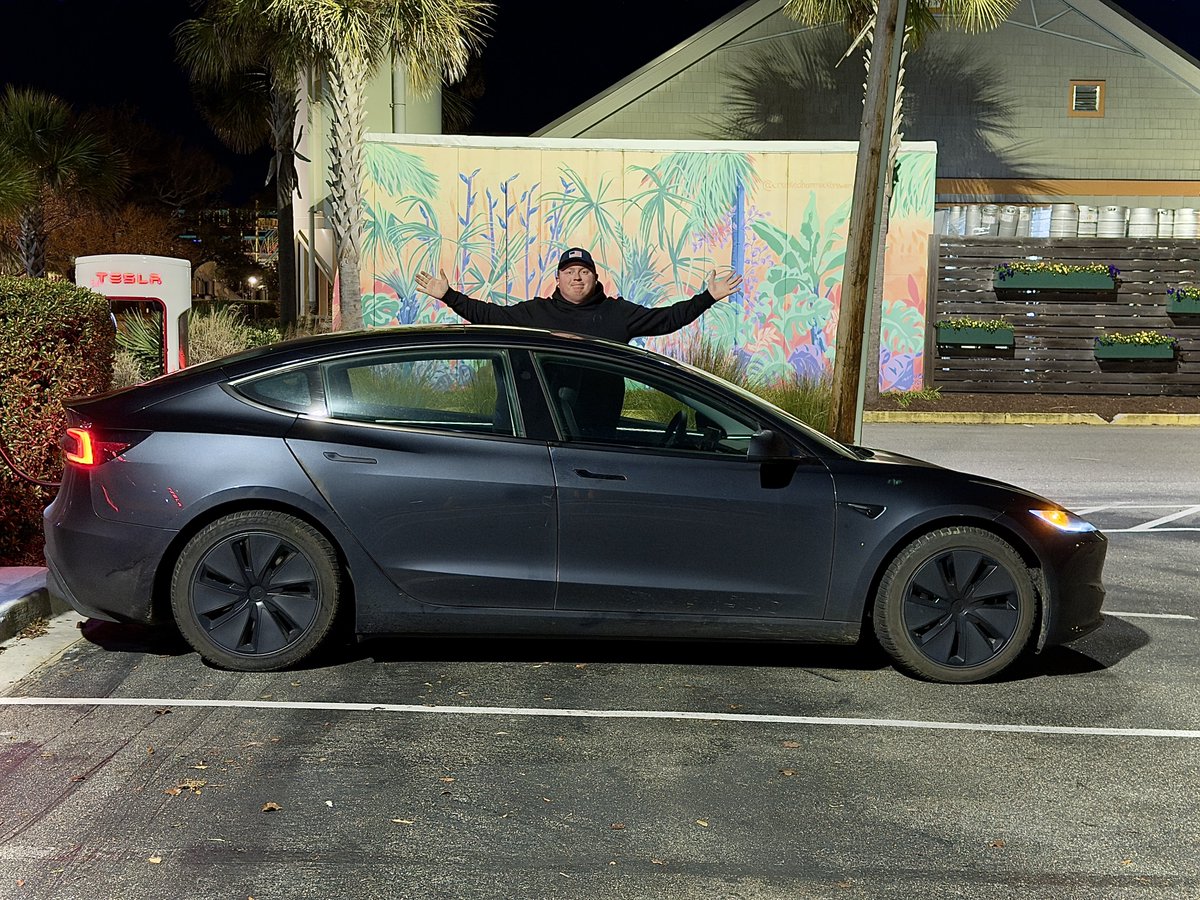
I am proud to announce that I have successfully completed the world’s first USA coast to coast fully autonomous drive!
I left the Tesla Diner in Los Angeles 2 days & 20 hours ago, and now have ended in Myrtle Beach, SC (2,732.4 miles)
This was accomplished with Tesla FSD V14.2 with absolutely 0 disengagements of any kind even for all parking including at Tesla Superchargers.