Links: Week of 08 Mar 2026

Savitha Shan, an undergrad double major here in economics and information systems, who was murdered over the weekend by an Islamist terrorist who started randomly shooting people on Sixth Street, apparently angry about the war in Iran. Two other innocents were also killed. - Scott Aaronson
So senseless. And the 180 schoolgirls Minab, Iran. Did any of them know it was their time? Did they get to live a full life? Will I? It's one thing to know this and another to feel it in your bones. But the worst is when you start feeling it and your self-preservation instinct kicks in - allowing the feelings to only go in so deep and no more. RIP.
Links
The Brand Age: Worth reading the whole thing just for this sentence but there's a lot more and it ends in a very different place from where it starts.
This is an instance of what I call the comb-over effect: when a series of individually small changes takes you from something that's a little bit off to something that's freakishly wrong.
The Hidden Advantage of Being Over 50 in the Age of AI: Hope & cope?
The leaders who win this era won’t just be 22‑year‑olds building AI‑native startups. They’ll also be experienced operators who integrate AI quietly and intelligently into systems they already understand. If you’re over 50 and feeling behind, you might actually be early. Because when the tools get easier, experience becomes more powerful—not less. And this time, that experience may finally be the competitive edge.
- BC
I'll provide a little more specificity on this, and snippets of an example.
For many months people have been talking about a "Cursor moment" in finance, where workflow changes so dramatically that you hit the steep part of an adoption curve. I've been highly skeptical of that, for a few reasons.
But the most fundamental reason is the LLM technology just wasn't there. The foundation models simply did not have enough power to interact with Excel spreadsheets in any sort of usable way (despite splashy demos...). Even if you solve the (very hairy) data challenges, 2025-era LLMs just didn't have the power to interact with spreadsheets.
So we could sit and talk about a lot of ideas and concepts on how AI could augment institutional investment research. But it was just that, a concept.
I have a series of tests I run on new AI models that are capability tests for hedge fund style research workflows. And the easiest is just uploading an existing Excel file to see if the LLM can understand what's going on. If LLMs can't sufficiently read and understand an Excel model, the full stack of AI Excel workflows is just not possible (in my opinion). And a waste of time to try to explore.
This didn't work to any sort of impressive degree (Opus 4.6 could do it, but not do it well). Until yesterday, with GPT-5.4 Thinking.
Suddenly, I can now get something that is not only modestly useful, but I think will immediately become part of my investment process workflow.
I call it "PM Review", or a structured evaluation and push back on a model. I have participated in literally hundreds of these as both analyst and PM. Effectively the analyst builds a model, sends it to the PM, and they walk through it together. The wise, experienced-scarred PM will rip the model apart, push back, and help steer the model to a usable outcome.
A great PM will be able to hone in on the two or three key variables that matter and identify aggressive or conservative assumptions. An analyst may be pitching a stock where the core quantitative input is supported by flawed logic. And the PM's job is to try and identify that flawed logic. This workflow, to me, is a key differentiator between good and not good PMs.
However this workflow isn't just for PMs; it's for analysts who are trying to evaluate their own work, peer analysts who want to do thoughtful push-back on ideas the team may participate in, our director of research teams who are looking to efficiently evaluate the idea underwriting process. Or PMs for the first cut if they're looking at lots of ideas.
The intriguing aspect of augmenting this process with AI is it scales incredibly. And it can run autonomously. Across 300 models I could have a swarm of agents doing automated due diligence on the key drivers, updating those models, feeding those results back to me, and flagging which of my covered ideas have earnings revision potential. This workflow is the "Cursor moment" for public equity research, in my opinion. I'm not saying we're there by any means as data accuracy and the structures required to incorporate internal data are still in progress. But we just took a step forward in the technological capability.
I tested this out in GPT-5.4. And while it's not perfect this is the first time I've received anything that's useful back in this test.
I'll walk you through a couple of steps to do this on your own.
Step 1: brain dump into Claude. I don't know if there's any logic to it or just my own habit but if I'm executing in Chat GPT, I'll meta prompt and Claude and vice versa. I'm not sure where you meta prompt matters all that much for the types of workflows I do but it CERTAINLY matters if you meta prompt vs. raw prompt so don't skip this step.
Step 2: take that prompt output, turn it into Markdown, and put that as custom instructions in a GPT project. This is just a workflow efficiency because then I now have a GPT project that I can upload any model into.
Step 3: run the prompt. I purposely jacked up my DraftKings model a little bit (and it's a work in progress anyway so do not take any of these estimates as anything I believe).
But it produced an exceptionally helpful:
1) Executive Summary
2) Business understanding (explaining how a dollar flows through P&L)
3) Model Evaluation, providing an assessment and sanity check of all of the key inputs
4) Model audit, looking for input consistency, formula integrity, and broken references
5) A road map for incremental due diligence
6) The highest value IR questions
I encourage you to check it out for yourself.
Will link to the six-page output in the replies.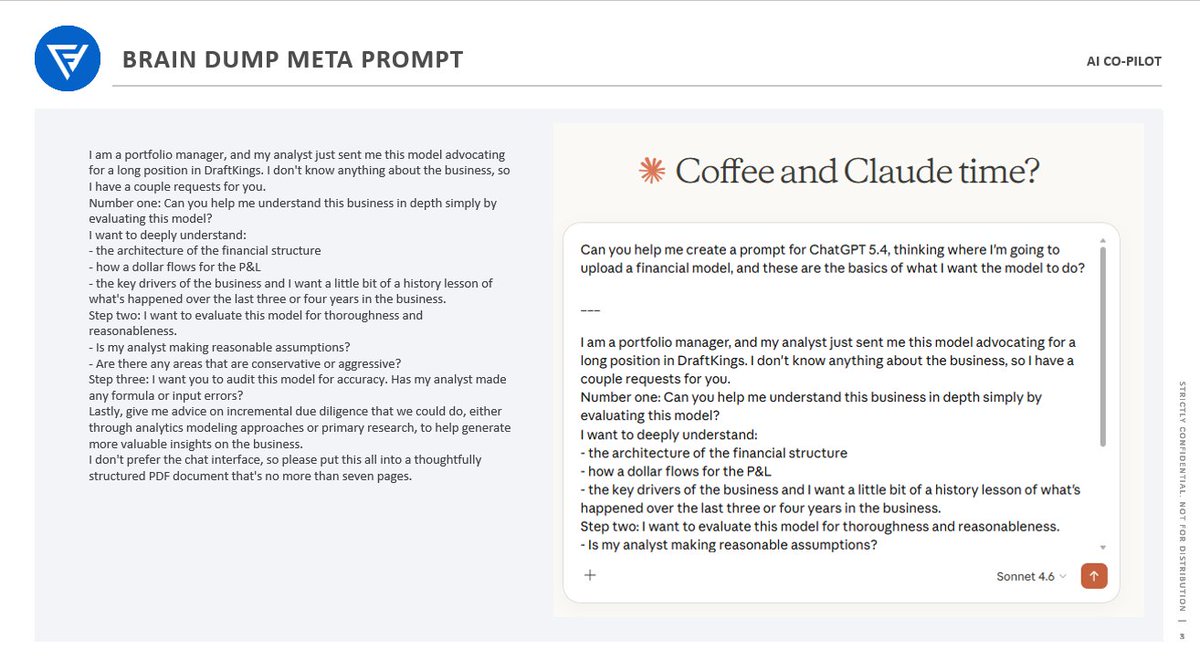
- C
You want me to be physically present at a meeting in the office? Like the Ayatollah?
I wouldn't stand there.