September 11, 2026 10 min read

No, Julius Bär! Singapore Is Not the World’s Most Expensive City

The Julius Bär Global Wealth and Lifestyle Report 2026 made some headlines recently, naming Singapore as the most expensive city in the world for the second year running. As someone who's lived in Singapore for more than 20 years, and moved to the NY/NJ area earlier this year, my first reaction was to ask what they're smoking and where can I get some of it. Clearly not in Singapore, which would probably save you some money right there vs NYC.

As a recent transplant, this is a topic near to my heart and I have opinions. Those opinions could not be more different from those of Julius Bär. It's not even close.

First, a bit of throat clearing. The report explicitly focuses on a "premium standard of living" i.e., for high net-worth individuals and not hoi polloi like moi.

Second, it really isn't even a proper cost-of-living index since the methodology is to simply compare the cost of 20 seemingly random "premium" items. This includes housing, cars, fine dining, private schools but also women's handbags, LASIK and an MBA (what?). And within those, housing has a weight of 20% and cars of 10%. All other items have an equal weight of 3.89%.

20% on housing I can swallow. But 10% weight on cars? Talk about a measure rigged to make Singapore look worse. Singapore famously has very high taxes on cars. Your base model Toyota Corolla is listed for about US$158,000 as of Sep 2026. You could get one for about US$22,500 in the US. So yeah.

Clearly the purpose isn't so much to capture a true cost of living for anyone but to grab some headlines, which it has done very successfully. But I'll take the opportunity to share my experience of day-to-day living in the two places anyway.

Let's start with the simple stuff (all prices in US$, unless specified).

Transport Buying a car is more expensive in Singapore and so is petrol / gas. But I gave up my car in Singapore a few years ago and didn't miss it for a second. You don't really need one in Singapore or, for that matter, NYC. The MRT / subway, buses and Uber / Grab will get you everywhere in both places more than adequately.

The base fare for the MRT is about $1 with a maximum, depending on distance, of $2. The base (and only) fare on the NY Subway is $3. So your basic 44 rides a month commute will set you back about S$55-115 while the same commute in NYC would cost you US$130. US$1 is about S$1.27.

This is a pattern I have observed again and again. While the SG$ is cheaper, the SG$ prices in Singapore are lower than the US$ prices in NYC. Adjusting for currency, the NYC Subway is about 50% more expensive.

Arguably this isn't a fare comparison (heh heh) because you could use your pre-tax income via some commuter-benefit accounts (if you don't live in the US, you don't want to know), effectively reducing your cost by 10-30%+. Plus the NYC Subway caps weekly charges at $35, so if you were using the Subway for more than your commute, the remaining trips are effectively free, bringing down the total monthly cost. So maybe the Subway is not that much more expensive all in, but it ain't cheaper.

But. Many people working in the City commute from places like NJ suburbs, Westchester, Greenwich and Long Island. Let's just take the NJ Transit, which I know a lot more intimately than I would like to. A one-way ticket from Millburn runs about $10 and a monthly pass about $300. There is no gymnastics that will make this competitive with the MRT.

Now, let's adjust for quality. Aside from a brief period around 2015-16 if memory serves, the MRT is the definition of reliability. During peak hours there are trains every 1-3 minutes. The trains and stations are clean, air-conditioned, well-lit and safe. The NJ Transit runs trains every 30-60 minutes and is anything but reliable. The Subway is largely reliable but the remaining adjectives mostly do not apply.

Uber / Grab? The average fare I paid in Singapore was about $15, maybe less. I haven't used New York cabs at all but a ride of similar distance runs about $30+ here before tips. In Singapore, the premium paid for a cab was generally worth it because those would get you to your destination faster than the trains. This is probably mostly not true in NYC.

Food I cannot yet make a proper comparison between Singapore and NYC restaurants, because I really haven't eaten out in the city that much so far. I do think NYC has a much greater variety of food. For instance, to the best of my knowledge, Singapore had no Bhutanese, Georgian, Ethiopian or Uyghur restaurants while NYC has many.

However I can compare takeaway lunches available in the Singapore CBD and Manhattan Midtown, since I eat those every day. In Singapore I mostly had 3 meals on repeat, over the last 2 years. They were priced as follows: Thunder Tea Rice - $5, Veg. Soba Noodles - $8.50 and Mala Hot Pot - $10.50.

I would prefer those three to literally every single item I have had in NYC over the last 8 months. Perhaps this is a matter of taste, although I do not think so. It's possible that I have not explored broadly enough - I order off GrubHub, from a rotating cast of 2 restaurants daily, chosen by the office manager.

The cheapest meal I have had is probably $12 (excluding taxes and delivery charges). The average is closer to $16. The quantity of food I get is absolutely more than in Singapore but we are somewhere between 50-100% more expensive here.

Groceries? I haven't really noticed a huge difference between the two places on prices and NJ could be cheaper. Certainly some items like cheese are much cheaper in the US and large format grocery stores have more variety. However, between RedMart delivery and the local wet market, I probably spent no more than 2-3 hours a week on groceries in Singapore. Here my weekly Costco trip consumes about 3-4 hours with the added expense of the inevitable lunch or dinner out after the run. This may be a skill issue. We will see.

What about eating out in the suburbs? There is surprisingly good Asian food in Millburn and surrounding towns but the sticker (after tips) on each trip out is probably identical to the SG$ number of an identical trip in Singapore. So 25% more.

Renting We never seriously explored the option of living in Manhattan so this isn't something I have a lot of experience with. But a quick Google search shows the median rent on a 1 bedroom Manhattan apartment runs around $4,500 and a 3 bedroom runs about $6,000-7,500. The 1BR rate "feels" a lot higher than what you would see in Singapore, possibly even in SG$. The 3BR rate is probably in line.

But I suspect the average apartment in Singapore is newer, nicer and has access to more facilities than the average NYC apartment. All but the first apartment that I had in Singapore had lap pools, gyms and many had tennis courts, function halls and some even had large play areas for kids. All were within a 15-30 min commute to the CBD. Based on what I have seen, I doubt that those prices are getting anything even close in terms of quality in NYC.

Childcare This is the big one - in price and in quality. The FDW system in Singapore means you have full-time, high-quality domestic help available for an all-in cost of, call it, $1,000-1,500 a month.

In the US, of course, you must pay by the hour. In NJ, that is about $25/hr. A full-time nanny is probably $5,000 a month plus taxes. If you can't find one, before school and after school care runs $200-300 a week, if not more.

The cost comparison is quite one-sided. The quality of life difference is too vast for my vocabulary.

Healthcare In Singapore, my own insurance (not employer provided) for the whole family was about $3,000 a year for in-patient coverage of about $750K per person per year for in-network, approved treatments. No outpatient coverage but also no deductible for in-network.

You could easily go to a "neighbourhood clinic" for outpatient visits and we often did, incurring about $40 per visit. Specialists were more expensive and a fairly wide range, from $100-250 for pediatricians to $400 for an orthopedic surgeon and ophthalmologist. ER visits probably averaged $150.

I have an employer-paid health plan in the US that I am told costs about $25K for the family, has a $5K deductible and a $7K out-of-pocket cap. A visit to the urgent care cost about $100. So experience so far isn't too bad but we have all heard the horror stories.

The somewhat non-obvious tradeoff there is that there is no upper limit for the US policy (for covered in-network expenses) while the Singapore policy does have one. The US policy is more of a true "insurance" in that sense - you are fully protected in a catastrophic outcome and there is a strong incentive to avoid unnecessary consumption of healthcare.

Singapore is the opposite - 0 in-network deductible can encourage overuse (though harder with in-patient) and it caps out for the truly catastrophic scenarios. Still, $750K is a lot for most cases and the $3,000 vs. $25,000 a year is nothing to sneeze at.

Taxes It is pretty clear with all of the above that NY is more expensive than Singapore, certainly for the non-HNWIs. Common prices are easily 30-50% higher.

But remember, these are all after tax and taxes in the US are much higher.

Even at fairly high incomes, the average income tax rate in Singapore is sub 20% all in. In fact the highest marginal income tax rate is only 24%. In US, you hit 30%+ federal tax rate quite quickly. You also hit the 6-7%+ state tax and additional 4% or so tax in NYC for NYC residents quite quickly.

So that S$100 meal in Singapore, that was US$100 in NY for a 27% gap, is really more like S$115 in Singapore and US$140 in NY for nearly 55% gap.

Perhaps you are a HNWI - living off your capital gains. Well, Singapore has 0 capital gains tax while the US most certainly does not.

The impact of taxes is also quite significant when it comes to housing. We compared rentals earlier.

It's a tad harder to compare prices for homeownership between the two places, especially if you are in the NY suburbs.

Having lived for a long time in Singapore and looked around for a while around NY/NJ suburbs, I am going to compare what feels subjectively similar between two locations - in terms of relative quality, status etc.

Apartments in Singapore are more expensive in most cases. Subjectively, $2-3 million in Singapore buys you the same relative quality / status that a $1-1.5 million house might buy in NY/NJ suburbs.

But the owner-occupied $2.5 million apartment in Singapore carries a $5,000 annual property tax bill while the $1.5 million house in NY comes with a $25,000-45,000 annual tax bill.

If it was an apartment in Manhattan, it might come with literally thousands in monthly maintenance / HOA charges!

I could go on. But combining all of this, it is not clear to me how you could invent a scenario where Singapore is more expensive than the US for most families - unless you are trying to do something the SG govt. is actively discouraging such as buying a car, or foreigners / speculators buying a property. For everyone else, it is not even close.

August 21, 2026 4 min read

Links: Week of 22 Aug 2026

  1. DT
    Derek Thompson@DKThomp · Aug 19

    New newsletter: CHANGE ALL YOUR PASSWORDS *NOW*

    Cybersecurity expert @alexstamos predicts that the next two years could be chaotic, as open-weight AI models with advanced cyber capabilities get into the hands of hackers, turning Grade C scammers into Grade A hackers; and allowing bad individuals to do the kind of work previously only possibly by large teams.

    Phishing attacks will become more sophisticated and more common, putting individuals at risk, and mid-tier companies with inadequate code and IT will cough up username-password combinations at an accelerated clip.

    The time to up your password game—and to get your parents and older relatives to up their own—is now.

    Repeating this theme from last week. This is absolutely one of the top concerns for me these days - scammers will come for us all in increasingly sophisticated ways and just one mistake can be costly. Password managers to create unique and complex passwords, 2FA where possible are the bare minimum. What other steps do we need to take?

    Do we all need family & friends passwords / passpharases to ensure you are talking to a family member on the phone, when they ask for money / help? Do we need to diversify our financial accounts so that the damage is limited if one is compromised? What about protecting / recovering from the mental health impact after being scammed - see the piece on the jury duty scam from last week. The emotional tolls on the scammed person and their relationships can be huge.

  2. In July, one bookseller told me they received a very large order of around 1,000 books on Biblio, one of these marketplaces. The seller agreed to put an Apple AirTag provided by 404 Media in one of the books included in this order so we could see where the book was going. And by extension, which company, AI or otherwise, was behind this massive order.

    and

    The book ended up delivered to the VGT3 corner of the LAS8 Amazon facility in the north east of Las Vegas, where the entrance carried this on-the-nose logo of a dinosaur with a book! Online forum discussions between Amazon workers confirmed that VGT3 destructively scans large volumes of books.

    and

    AR
    Abhijay Rana@abhijaymrana · Aug 17

    Wow, seems like Google is buying Spirit Airlines' enterprise data for $10m (outbidding Mercor at $7.5m).

    Basically includes every internal document, email, workflow, and codebase for a once $6B company.

    Honestly, $10m for 34 years of operational data really seems like a steal.

    Clearly, the frontier labs have an unlimited appetite for human generated text, for training their models and the budgets to match. I wouldn't get too worked up about the destructive scanning of "rare" books - most are likely rare for a good reason. And as long as they are saving the scans, I wouldn't worry that we are losing much here at all and in fact this might even be a net gain.

    The question I have is how long will these scans be saved by the labs. The cost of permanently saving such a large trove may not be trivial and even if it is, some corporate boffin 10 years down the line may decide to "optimize".

    The ideal solution would of course be for the labs to make these scans open and accessible but that would mean open to their competitors as well, and that is something I don't see happening.

  3. A few more vibe-coded projects.

August 14, 2026 3 min read

Links: Week of 15 Aug 2026

  1. And another one here:

    C
    Crémieux@cremieuxrecueil · Aug 12

    This is really fun:

    Someone made a little app that let's you drive a car over India's inflation rate.

    Can you make it through the chaotic 1970s? Glide through the 2020s?

    Give it a try: https://timeseriesofindia.com/economy/play/inflation-peaks/

  2. Having moved cities over ten times myself (yes, I’m tired), I’ve begun to learn the same lesson of how distance reshapes closeness, and how friendship bends without always breaking.

  3. MB
    Miles Brundage@Miles_Brundage · Aug 14

    Folks.

    The hackers (human and AI and various permutations thereof) are coming for you - yes, you.

    Use two factor authentication and unique passwords saved in password managers for everything.

    I cannot repeat this enough. This should be priority #1 for everyone.

    But that is not enough. Other scams are also getting more sophisticated and will get more so with AI. This is something that has been at the back of my mind for a while now.

    What other defesive steps can one take? Awareness is one. Does diversifying your assets across platforms make it safer or weaker? Is there resonable insurance available for this? Even if you make a mistake and fall for a scam?

  4. In 1950, the shortest-lived 1 percent of babies born in France lived less than three months. But for babies born after that, that 1 percent started surviving longer and longer: up to six months for those born in 1960, three years in 1970, 18 years in 1980, and 25 years in 1990.

  5. If we could have devised an arrangement for providing everybody with music in their homes, perfect in quality, unlimited in quantity, suited to every mood, and beginning and ceasing at will, we should have considered the limit of human felicity already attained.

    I can never have too much gratitude for the era I get to live in. Perhaps the future will be even better but the difference today versus just a 50 or 100 years ago is enormous - medicine and technology are miracles.

  6. In wealthy countries, consumers and companies have shifted to producing and purchasing more cage-free eggs. Today, 45 percent of American, 62 percent of European, and 82 percent of British hens are kept in cage-free facilities. That amounts to hundreds of millions of hens spared from cages each year. Hens get two to three times as much floor space, which means each egg costs one or two cents more to produce. Richer consumers are willing to absorb those small costs.

  7. And yet, when we asked men what was more important to them — career success or getting married and having children — 44% of men prioritized family while 41% prioritized work, around the same shares as women. Among conservative men, the share prioritizing getting married and having children was even higher.

August 7, 2026 5 min read

Links: Week of 08 Aug 2026

  1. I first posted about the attack on HuggingFace by OpenAI's models a couple of weeks ago. This has since beomce a huge story, though I am surprised at the relatively small political response.

    Zvi Mowshowitz has the best coverage of the topic, as usual, and as he points out, the more details we hear, the more concerning it gets. I haven't yet watched the technical presentation from OpenAI on this (see video below) but it is being widely shared and recommended.

    This time the models used a message board in English and using a tool provided to them. The models obviously have the capability to create their own secret messaging boards and languages, that would be unitelligible to us. How long before they switch to that?

    I have not so far been in the doomer camp when it comes to AGI and ASI but surely it is worth considering now?

  2. NB
    Noam Brown@polynoamial · Aug 1

    An internal version of Astra, @OpenAI’s next major model family, solved 10 major open problems in mathematics, quantum complexity, and theoretical computer science.

    We believe it will be a major step for scientific reasoning. https://openai.com/index/ten-advances-in-mathematics/

    NB
    Noam Brown@polynoamial · Aug 1

    The cost of generating the proofs for all 10 of these breakthroughs combined was under $2,000 at Sol API prices. We’re excited to see what scientists and researchers are able to create with our upcoming Astra models!

    This seems huge. LLMs are clearly shaking up Mathematics.

    TB
    Tamay Besiroglu@tamaybes · Mar 10

    I bet @littmath that in 5 years AI will be able to produce Annals-quality Number Theory papers at an inference budget at or below $100k/paper, at 3:1 odds in my favor.

    DL
    Daniel Litt@littmath · Aug 1

    Incidentally I am conceding this bet. Strictly speaking it hasn’t resolved (I think we’ve yet to see an Annals-quality number theory paper) but it’s clear I was wrong about what capabilities were necessary to produce one, and it’s just a matter of time.

    Noah Smith digs into some of the implications here. Not everyone is taking it well so far and I have more than a little sympathy.

    I am going insane. During the last week or so LLMs have produced a number of counterexamples to significant long-standing conjectures. I will not recount these happenings here, there are many places where you can find the details.

    Mathematicians, math enthusiasts, and curious laypeople are responding to these developments in ways that I believe obscure what is, for me, the true heart of the problem. I do not speak for everyone in the math community in my response. But I suspect I am not alone.

    I am suffering a profound spiritual crisis due to these developments. I have been screaming internally for days. It feels as though I am living inside of a nightmare. The recent Leiden Declaration on Artificial Intelligence and Mathematics is, to me, a well-muffled scream. A saccharine mélange of self-soothing over which looms a painfully obvious absence.

    Is it coming for us all? Get harder to argue against everyday.

    DL
    Daniel Lockyer@DanielLockyer · Aug 7

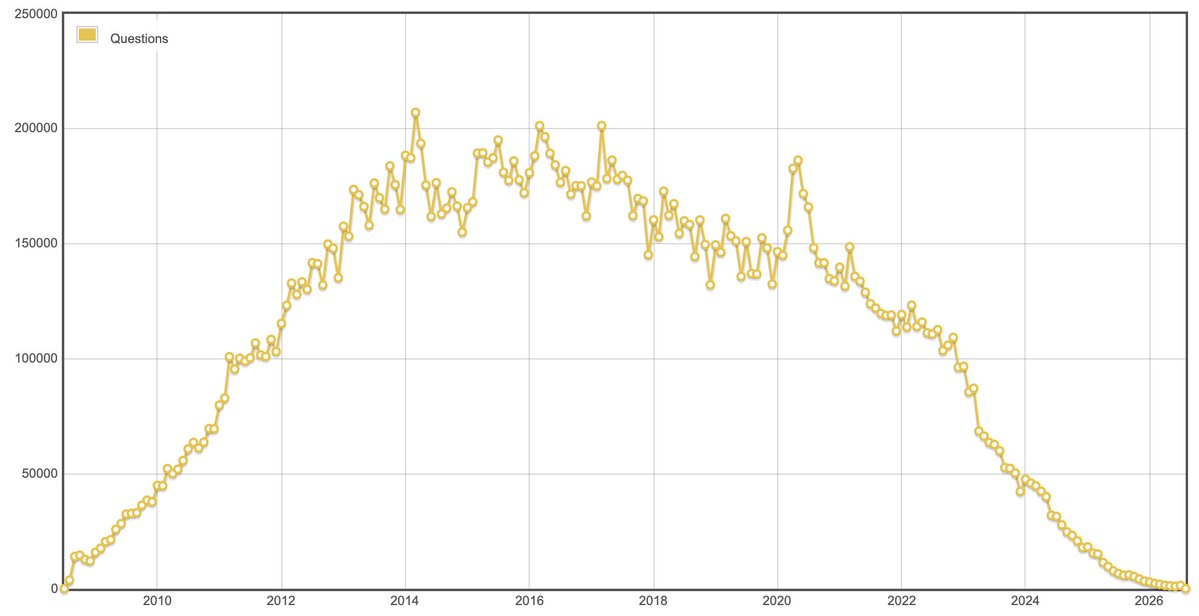
    Stack Overflow has gone from a peak of 207k questions in march 2014, down to 1.4k in july 2026

    end of an era

  3. Just start. It’s so easy to get caught in the trap of obsessing over the design of your blog, and planning for content that you never actually get around to writing. As long as each entry has a date on it and a permanent URL, it counts as a blog. I think adding an Atom or RSS feed is important too, but you can get started without one — don’t treat that as a blocker.

    and

    Me, I try to get into the mindset of playing live music, not recording a studio album. Except when I’m writing a piece where I really want it to be an album. Those aren’t rare, per se, but they’re occasional. If I tried to make every post a hall-of-famer I’d never get anything out.

Light posting continues with only three items today but they are all heavyweight ones. I spent a fair amount of time reading and thinking about each this week.

I am starting to come around to the view that it is time for me to start writing. Simon Willison and John Gruber are not the first ones to point out that writing is thinking. You cannot really think well if you do not write. I have read this many times.

It is time for action now. As things stand today, probably a maximum of three people read this blog with any degree of regularity. I will avoid commenting on whether I make up one of those three.

What that does mean is that I can dance here like no one's watching. Because no one is.

July 30, 2026 2 min read

Links: Week of 31 Jul 2026

  1. The best way I’ve found to explain the dilemma comes from the AI researcher Daniel Meissler: it’s the difference between work and the gym.

    At work, if your job is to move a bunch of heavy things from one side of the room to another, you should use whatever assistive tech you have on hand: a wagon, a forklift… even an AI-powered robot. But at the gym, it makes no sense for that robot to lift weights for you. The point of weightlifting isn’t to move heavy things across the room; it’s to actually lift those heavy things.

    The same analysis holds for any task an AI can do for you. If it’s work—if the task has to be done and no one cares how—then it’s fine to use AI assistance. But if the task is more like the gym, and how the task is done is at least as important, then it probably doesn’t make sense to use AI.

    Great analogy and a contender for the best link of the year.

  2. J
    juan@juanbuis · Jul 28

    i can’t believe someone solved recipe design decades ago and everyone just decided to ignore it

  3. We summon a car in three minutes. A package arrives the same day. AI answers complicated questions in seconds, and does more complex work that took people months in mere minutes. Naturally, citizens begin to expect similar efficiency from government. But democracy is not designed for speed. It is designed for legitimacy. It bargains, compromises, consults courts, protects vulnerable groups and balances competing interests. Those safeguards are precisely what distinguish democracy from authoritarianism. Yet in an age shaped by technology’s warp speed, they increasingly look like paralysis.

Light posting continues. Wonder if this is a sign that its time to start writing rather than linking?

July 24, 2026 4 min read

Links: Week of 25 Jul 2026

  1. We now live in a digital age. If perfect reproductions of our best efforts as creators are free, how can we keep going? To put it simply, how does one make money selling free copies?

    I have an answer. The simplest way I can put it is thus:

    When copies are super abundant, they become worthless and stuff which can’t be copied becomes scarce and valuable.

    When copies are free, you need to sell things which can not be copied.

    Well, what can’t be copied?

    Originally written at the dawn of the internet era but it becomes even more relevant in the age of AI. I wonder if this is part of the reason FIFA World Cup tickets were so expensive this time - LIVE can't be copied.

  2. L
    levent@__alpoge__ · Jul 19

    hello there the jacobian conjecture is false thanx to my close friend akhil for asking about it and my other close friend fable for working during the world cup final

    ((1+xy)^3 z + y^2 (1+xy) (4+3xy), y + 3 x (1+xy)^2 z + 3 x y^2 (4+3xy), 2 x - 3 x^2 y - x^3 z): \C^3\to \C^3, has jacobian determinant -2, and sends (0, 0, -1/4), (1, -3/2, 13/2), and (-1, 3/2, 13/2) to (-1/4, 0, 0)

    and

    SW
    Shouqiao Wang@Qiaoqiao2001 · Jul 22

    I solved 6 open Erdős problems in 5 days, using @OpenAI GPT-5.6 Sol.

    I have a math background, but the Codex workflow I used does not require deep mathematical knowledge.

    Here’s exactly how I approached it, including my prompts 🧵

    Many such tweets over the last few days. Clearly AI has disrupted Mathematics. Time for denial is past - it is coming for us all. To use a strong cliche, remember this is the worst it will ever be.

This is the third straight week of light posting. I wonder what is going on? Surely I read more than three interesting things last week but I seem to not be saving them. Losing interest in the blog or just busy? I guess we will find out.

  1. That reminded me of this post from Ethan Mollick: An opinionated guide to which AI to use to do stuff

    If you turn on the “computer use” option in Code or Codex, the AI can literally take over your mouse, browser, and computer. Yes, this is a security concern, so you should proceed carefully, yet the results can be amazing. I asked ChatGPT-5.6 Sol in Codex to download a 3D modelling program and use it to create a very particular design: “Download Blender and make an otter using a laptop on an airplane.” Here is a sped-up video of the AI doing exactly this.

    Watch that video - I couldn't link to it directly. Not that it wasn't before, but this is starting to look like magic more and more. To repeat myself, it is coming for us all. And all the more reason to read that first link.

July 17, 2026 2 min read

Links: Week of 18 Jul 2026

  1. GOAT. Clearly.

    BR
    Bleacher Report@BleacherReport · Jul 16

    Adam Silver says next season’s schedule is on hold until LeBron makes his decision ⏳👀

    "We have to finish up the schedule and where LeBron plays affects the schedule ... opening week, Christmas. So I need him to make a decision."

    (via Game Plan, @CNBCSport @boardroom)

  2. His first Appalachian Trail age record was broken in 2021 by a hiker named M.J. Eberhart, trail name “Nimblewill Nomad.” Mr. Sanders befriended Mr. Eberhart that year and encouraged him to set a new mark. “He was going to quit several times,” Mr. Sanders said. “I actually went up and hiked with him the last few days so that he wouldn’t quit. We’re really close friends.” Still, Mr. Sanders wanted the record back. For the current attempt, he planned to hike 12 miles a day, with one day off a week.

    GOAT! Who knew the Appalachian Trail was a regular geriatric magnet.

  3. Roughly 37,000–40,000 Americans die in auto accidents every year. We now have large‑scale, real‑world evidence—from Waymo and a joint analysis with Swiss Re—that driverless operations can be substantially safer than matched human driving within their current operating domains. The latest data show that over 220 million miles driven, Waymo vehicles–in Los Angeles, San Francisco, Phoenix, Austin and Atlanta–have 94% fewer serious injuries, 82% fewer air bag deployments, and 93% fewer pedestrian injuries. The evidence is not fully independent, but it is unusually transparent, large‑scale evidence.

    So with thousands of lives annually in the balance who is against autonomous vehicles (AVs)? Trial lawyers.

July 10, 2026 3 min read

Links: Week of 11 Jul 2026

  1. AK
    Ara Kharazian@arakharazian · Jun 30

    We can finally say AI isn't killing jobs.

    A new paper from me, @tryramp, and @RevelioLabs uses firm-level spend and workforce data across 21K U.S. businesses to measure AI's impact on jobs.

    Firms that adopt AI heavily grow headcount 10% over two years following adoption. Low adopters see no statistically significant change.

  2. How absent are women from city streets in the developing world? We answer this question using GPS-linked wearable cameras and randomized street audits across ~900 kilometers of roads in greater Mumbai. Across 4000+ street images containing 23,000+ visible person observations, women account for 16.4% of visible people in Mumbai and 14.7% in Navi Mumbai, far below their population shares. We estimate pedestrian sex ratios of 239 and 223 women per 1,000 men, implying 71% and 76% of women expected based on residential ratios are missing from the streets. This pattern holds across road types, and private mobility does not explain the gap; women’s share on two-wheelers is lower still (8.4% and 5.7%). These results provide the first large-scale measurement of gender disparities in urban public life that self-reported data cannot capture.

    Here is the actual paper.

  3. We translated an all-star panel discussion about the state of Chinese AI, in which panelists argue that China’s success with open source cannot compensate for the persistent and widening gap with US closed models. Qwen’s former tech lead estimated that there’s only a ~20% chance (“already very optimistic”) that the leading AI model in 3-5 years will be a Chinese one.

    and

    How Much AI Does $1 Get You in China vs America? In February, Aqib calculated that American chips are so much better than Chinese ones that, even with cheaper Chinese electricity and construction, $1 gets you more FLOPS in the U.S. (24 GFLOPS/$) compared to China (14 GFLOPS/$). We found that construction and chips account for almost all of the cost of running a data center, and other bills like electricity and water are basically rounding errors.

  4. Over the weeks that followed, Whitten got bills from both hospitals. Everything was roughly what he expected, and all of it would be covered by his insurance plan. But a few months later, Whitten got another bill—this time from American Medical Response, the ambulance provider that had transferred him between hospitals. The ambulance ride, he learned, would cost him $12,873: $737 for the miles traveled, $314 for monitoring his heart on the trip, $151 for infection control, and $11,670 as a “base rate.”

    So why are American ambulances so expensive?

    The standard answer is greed: rapacious ambulance operators, owned by villainous private equity firms, exploit patients at their most helpless. But I don’t think that’s actually what’s going on. Ambulance providers are chronically unprofitable businesses; margins are thin, crews are underpaid, and operators exit the industry every year. Whatever is being extracted from patients like Whitten, it isn’t padding anyone’s pockets.

    David Oks strikes again. The depth and breadth of his blog is unmatched. Read the whole thing.

    This is a textbook example of why, when you read yet another article about the "greed" of corporations being responsible for one of our problems, you should be skeptical. It "sounds" true, but usually is as far from truth as it gets.

July 3, 2026 5 min read

Links: Semiquincentennial Day

  1. CG
    Cardiff Garcia@CardiffGarcia · Jun 26

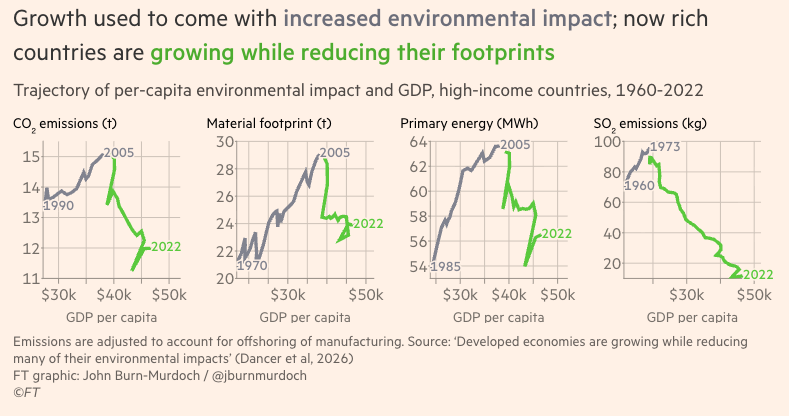
    A truly striking chart in @jburnmurdoch's latest (link next):

    One of the most important charts of the year. Growth, for the lack of a better word, is good.

  2. New business models enabled by AI starting to come into focus.

  3. AK
    Andrej Karpathy@karpathy · Feb 10

    # on shortification of "learning"

    There are a lot of videos on YouTube/TikTok etc. that give the appearance of education, but if you look closely they are really just entertainment. This is very convenient for everyone involved : the people watching enjoy thinking they are learning (but actually they are just having fun). The people creating this content also enjoy it because fun has a much larger audience, fame and revenue. But as far as learning goes, this is a trap. This content is an epsilon away from watching the Bachelorette. It's like snacking on those "Garden Veggie Straws", which feel like you're eating healthy vegetables until you look at the ingredients.

    Learning is not supposed to be fun. It doesn't have to be actively not fun either, but the primary feeling should be that of effort. It should look a lot less like that "10 minute full body" workout from your local digital media creator and a lot more like a serious session at the gym. You want the mental equivalent of sweating. It's not that the quickie doesn't do anything, it's just that it is wildly suboptimal if you actually care to learn.

    I find it helpful to explicitly declare your intent up front as a sharp, binary variable in your mind. If you are consuming content: are you trying to be entertained or are you trying to learn? And if you are creating content: are you trying to entertain or are you trying to teach? You'll go down a different path in each case. Attempts to seek the stuff in between actually clamp to zero.

    So for those who actually want to learn. Unless you are trying to learn something narrow and specific, close those tabs with quick blog posts. Close those tabs of "Learn XYZ in 10 minutes". Consider the opportunity cost of snacking and seek the meal - the textbooks, docs, papers, manuals, longform. Allocate a 4 hour window. Don't just read, take notes, re-read, re-phrase, process, manipulate, learn.

    And for those actually trying to educate, please consider writing/recording longform, designed for someone to get "sweaty", especially in today's era of quantity over quality. Give someone a real workout. This is what I aspire to in my own educational work too. My audience will decrease. The ones that remain might not even like it. But at least we'll learn something.

  4. SpudCell is a synthetic cell made by scientists at the University of Minnesota. It was created in a lab from lifeless chemicals but can perform most of the same functions as living cells. It eats, grows and reproduces, passing along its genetic material to future generations.

    and

    We want to share an exciting update that we have generated the first early human egg cells (‘primary oocytes’) derived from stem cells. After performing a simple blood draw, we converted blood cells into stem cells, and then coaxed those stem cells into becoming miniature human ovaries that contain the early eggs.

  5. WR
    Weave Robotics@weaverobotics · Jul 1

    Today, we’re launching our home robot Isaac 1.

    Isaac 1 deliveries will begin this fall.

    Order yours below.

    I am optimistic because unlike the rest, this doesn't promise the world - putting things in their place and folding laundry. $8K.

  6. No matter what you’re doing, from building a civilization on Mars to getting a summer internship, you will have to ask people for help. Yet, most people get this crucial skill wrong. They put themselves at the front of their request, when they should be putting the other person there. But isn’t getting help just charisma and luck? No, asking for help is a skill, not an attribute you are assigned at birth like green eyes.

  7. Frontier models we tested on struggle with relatively simple financial tasks, and model advances don’t improve performance much. In contrast, we’ve shown that high-quality proprietary datasets labeled by expert investors and used for fine-tuning produce custom models that exceed frontier performance on our tasks. We have found that this outcome holds true well beyond the six tasks we’ve discussed in this post.

    Aside from higher accuracy, custom models are also substantially cheaper. We expect to see more productivity gains from custom model training in the future, especially with the availability of training infrastructure like Tinker that enables rapid experimentation.

    Our results show the possibility of a future of differentiated intelligence, where custom models tuned to specific organizational needs outperform frontier models.

  8. AP
    Arindam Paul@arindam___paul · Jul 2

    As someone who sells mixer grinders, let me tell you that Tamil Nadu is the largest market for grinders. And by a long long way

    And grinder is often misspelt in search. Liking “ciling fan”

    So I don’t think this graphic can conclude that TN has the highest use of some same sex dating app just coz the app is called “grindr”

  9. Happy Semiquincentennial to those who celebrate!

    GO
    Gain of Fauci@DschlopesIsBack · Jul 3

    Washington’s Dream For America 🇺🇸😂

June 26, 2026 3 min read

Links: Weeks of 27 Jun 2026

  1. Cancer is now the number one killer of Americans over the age of 50. Not heart disease. Cancer. And the reason it kills so many isn’t that we can’t fight it. It’s that we don’t see it coming.

    and

    Galleri captures cell-free DNA from a standard blood draw — a single vial — and sequences the methylation patterns across the genome using next-generation sequencing. An AI algorithm trained on massive datasets then analyzes these patterns to determine two things:

    First, whether a cancer signal is present at all.

    Second, where it’s likely coming from — which organ or tissue type is the probable source. This is called cancer signal origin prediction, and in studies, Galleri has achieved over 90% accuracy in identifying the tissue of origin.

    The test result is not a diagnosis. It is a precision compass. It tells your physician: there is a cancer signal detected, and the predicted origin is your pancreas, or your lung, or your liver. Your physician then orders targeted follow-up imaging or biopsy to confirm or rule out the finding.

  2. A century ago, waterborne diseases levied similar costs to those posed by respiratory viruses like colds and influenza today: endemic, periodically epidemic, and widely accepted as an inevitable feature of human life. Then, at the turn of the twentieth century, we decided they didn’t have to be. Pharmaceutical advances and clean water infrastructure made cholera, typhoid, and dysentery rare across much of the world within a matter of decades.

    Why haven’t we already seen the same kind of transformation with respiratory viruses?

    Introducing Intercept, a $500M bet to make respiratory infections like colds and flu a thing of the past.

  3. “When we took him to Patna for trials, in the whole area, the news spread that there was a small left-handed batter from Samastipur who had exceptional talent,” Jha says. “He was selected in the state Under-17 team at the age of eight-and-a-half.”

    One of the most exciting stars in all sports.

  4. Over the past 12 months, the AI ecosystem generated $110 billion in revenue when you remove double-counting. The growth rate is healthy. Annualizing the most recent month’s revenues indicates a $175 billion revenue run rate. These revenues are growing faster than previous IT-oriented waves, roughly three times more rapidly than the mobile or Internet waves.

×